A competitive and data-driven environment means companies can no longer rely on intuition alone to manage growth. Leaders need clear visibility into what is working, what is not, and why. This is where performance indicators become essential. A performance indicator with Odoo enables businesses to monitor results in real time, align teams with strategic objectives, and make smarter, faster decisions.
As an integrated ERP, Odoo provides powerful tools to define, compute, and visualize key performance indicators (KPIs) across finance, sales, operations, HR, and customer management. Combined with structured KPI design and expert implementation by Doodex, Odoo transforms raw business data into valuable insights that drive sustainable growth.
Key Takeaways
- Performance indicators are essential for measuring and improving business performance.
- Odoo ERP centralizes data and automates KPI computation.
- Interactive dashboards enable real-time monitoring and trend analysis.
- Relevant KPIs support data-driven and strategic decisions.
- With expert implementation, Odoo becomes a powerful performance management system.
Key Takeaways
What Is a Performance Indicator?
Key Performance Indicators (KPIs): Core Concepts
Company’s Performance Indicators by Business Area
1. Financial Performance Indicators
2. Sales Performance Indicators
3. Customer Performance Indicators
4. Operational Performance Indicators
5. HR and Team Performance Indicators
Why Use Odoo ERP for Performance Indicator Management?
Performance Indicator with Odoo: How It Works
1. KPI Definition and Configuration
2. KPI Computation and Automation
3. Interactive Dashboards and Tables
Analyzing Trends and Making Data-Driven Decisions
Performance Indicators for E-Commerce with Odoo
Advanced KPI Management with Custom Odoo Modules
Best Practices for KPI Success with Odoo
How Doodex Enhances Performance Indicator Management in Odoo
Conclusion
FAQs
What Is a Performance Indicator?
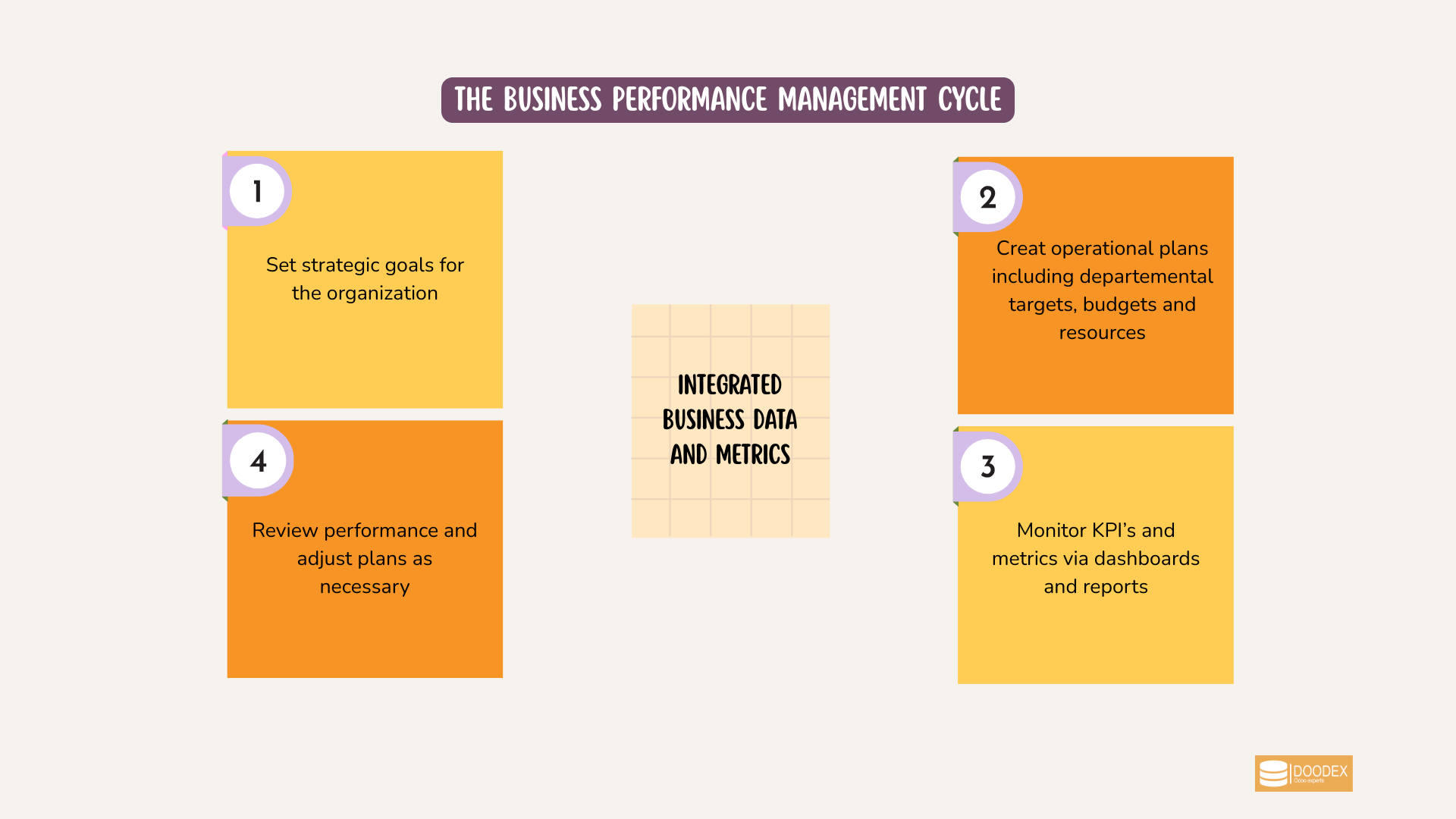
Business performance management cycle with KPIs
A performance indicator is a measurable value used to evaluate how effectively a company, team, or process achieves its objectives during a specific period. Performance indicators help organizations monitor progress, identify improvement areas, and assess whether actions are aligned with business goals.
Unlike raw metrics, performance indicators are purpose-driven. They focus attention on what truly matters for business performance, efficiency, productivity, and profitability.
Key Performance Indicators (KPIs): Core Concepts
Key Performance Indicators (KPIs) are the most critical performance indicators directly linked to strategic and operational objectives. They act as a compass for decision-makers.
Effective KPIs should be:
- Relevant to business goals
- Measurable using reliable data
- Comparable over time
- Actionable, leading to clear decisions
One common mistake is tracking too many metrics. KPI overload dilutes focus and slows decision-making. Odoo helps organizations select the right KPIs and concentrate on indicators that truly impact overall performance.
Company’s Performance Indicators by Business Area
1. Financial Performance Indicators
Financial performance is at the heart of business sustainability. Common financial KPIs include:
- Revenue growth
- Profitability and gross margin
- Cash flow and liquidity
- Cost structure efficiency
Odoo ERP centralizes accounting, invoicing, and budgeting, allowing financial KPIs to be updated automatically and analyzed without manual spreadsheets.
2. Sales Performance Indicators
Sales performance KPIs measure revenue generation and pipeline health:
- Conversion rate
- Average order value
- Sales cycle duration
- Revenue per salesperson
These indicators help sales teams track progress toward targets and optimize strategies, especially in B2B and e-commerce environments.
3. Customer Performance Indicators
Customer-focused KPIs measure long-term value:
- Customer satisfaction
- Customer retention rate
- Complaint resolution time
- Percentage of loyal customers
Odoo CRM and Helpdesk modules connect customer interactions directly to performance tracking.
4. Operational Performance Indicators
Operational performance indicators focus on efficiency and execution:
- Process cycle time
- Error and rework rates
- Inventory turnover
- Order fulfillment accuracy
These KPIs are essential for manufacturing, distribution, logistics, and service companies aiming to improve operational efficiency.
5. HR and Team Performance Indicators
Human capital directly impacts productivity:
- Employee productivity
- Goal achievement rate
- Team performance indicators
- Competency evaluation
Odoo HR modules allow companies to link individual performance to company objectives.
Turn KPIs into Action with Odoo Customization
Standard KPI's enough. Customize Odoo to track what truly matters
Why Use Odoo ERP for Performance Indicator Management?
Many organizations still rely on Excel files or disconnected tools to track KPIs. This approach creates data silos, delays reporting, and increases errors.
Odoo ERP offers:
- Centralized data across departments
- Automatic KPI computation from real transactions
- Real-time visibility for managers and executives
- Consistency between financial, operational, and customer data
With Odoo, performance indicators are no longer static reports but living tools for continuous improvement.
Performance Indicator with Odoo: How It Works
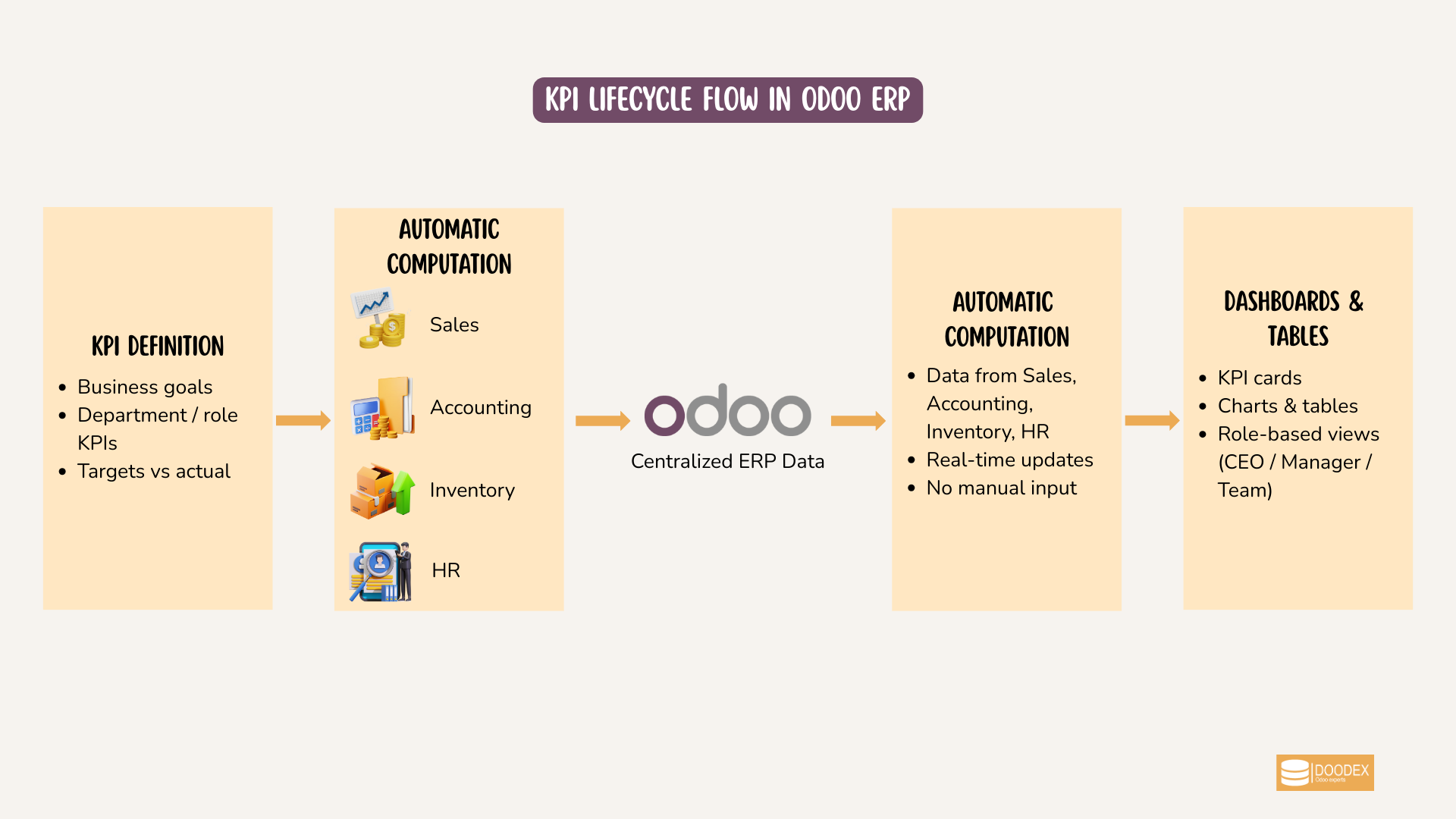
KPI lifecycle in Odoo ERP from definition to dashboards
1. KPI Definition and Configuration
Odoo allows businesses to define KPIs aligned with business goals:
- KPIs by department, role, or project
- Weighted KPIs based on strategic importance
- Targets versus actual performance
2. KPI Computation and Automation
Once configured, Odoo computes KPI values automatically:
- Real-time updates from sales, accounting, inventory, and HR
- Reduced manual work and errors
- Reliable data for informed decisions
3. Interactive Dashboards and Tables
Odoo enables users to:
- Create interactive dashboards
- Visualize trends using charts and tables
- Monitor KPIs by role (CEO, manager, employee)
These dashboards make complex data easy to understand and act upon.
Analyzing Trends and Making Data-Driven Decisions
Performance indicators only create value when they are analyzed. Odoo helps businesses:
- Analyze trends over time
- Compare planned vs actual results
- Identify bottlenecks and risks early
- Support strategic decisions with evidence
By transforming data into insights, Odoo supports a truly data-driven management culture
Performance Indicators for E-Commerce with Odoo
For e-commerce businesses, KPIs are essential to manage growth:
- Website traffic vs conversion rate
- Revenue by channel
- Customer retention rate
- Inventory availability and delivery time
Odoo connects sales, inventory, logistics, and accounting, giving online businesses a complete view of performance in one system.
✨Pro Tip
Track KPIs That Drive Decisions
Start with a limited number of key performance indicators (KPIs) that directly influence decisions.
If a KPI does not trigger an action, it does not belong on your dashboard.
Advanced KPI Management with Custom Odoo Modules
Standard KPIs may not cover all business needs. Custom Odoo modules allow advanced performance management:
- Company, team, and individual goals
- Quantitative KPIs and qualitative task evaluations
- Competency assessments and self-evaluations
- Automatic bonus and motivation calculations
- Hierarchical reporting and XLS exports
This approach is particularly valuable for medium and large organizations with structured performance evaluation processes.
Best Practices for KPI Success with Odoo
To maximize results:
- Focus on relevant KPIs aligned with strategic objectives
- Avoid KPI overload
- Review KPIs regularly
- Train users to interpret dashboards correctly
- Ensure ongoing support and optimization
Performance indicators are not a one-time setup but an evolving management practice.
How Doodex Enhances Performance Indicator Management in Odoo
Doodex helps companies go beyond standard reporting by:
- Designing KPI frameworks aligned with business strategy
- Building custom dashboards and KPI modules
- Integrating performance indicators across departments
- Providing long-term optimization and support
This ensures that performance indicators become a real driver of business performance, not just static reports.
Design Odoo Around Your KPI's
Create tailored modules for deeper performance insights
Conclusion
Performance indicators are no longer optional tools reserved for large enterprises. In an environment where margins are tight, customer expectations are high, and teams are increasingly distributed, measuring performance accurately is a prerequisite for sustainable growth. Without clear indicators, companies operate reactively, relying on assumptions instead of facts.
Using a performance indicator with Odoo changes this dynamic. By centralizing data, automating KPI computation, and providing real-time interactive dashboards, Odoo enables organizations to move from fragmented reporting to continuous performance control. Financial performance, sales efficiency, operational execution, customer satisfaction, and employee productivity can all be monitored within a single, coherent system.
However, technology alone is not enough. The real value comes from selecting relevant KPIs, aligning them with strategic objectives, and embedding them into daily management practices. When performance indicators are well designed and consistently reviewed, they become a powerful management language shared across teams.
With the right structure, training, and long-term optimization, Odoo becomes more than an ERP. It becomes a decision-making engine that transforms data into insight, insight into action, and action into measurable results.
FAQs
It is a measurable KPI configured in Odoo ERP to track business, financial, operational, or HR performance in real time.
KPIs are computed automatically using live data from Odoo modules such as Sales, Accounting, Inventory, and HR.
Only a limited number of relevant KPIs aligned with business goals should be tracked to avoid information overload.
Yes. Odoo integrates finance, operations, sales, and HR in a single system for unified performance analysis.
KPIs should be reviewed regularly, typically monthly or quarterly, depending on business objectives.
Absolutely. Odoo scales from small businesses to large enterprises and supports e-commerce KPIs effectively.
Custom modules are recommended when businesses need advanced goal management, performance assessments, or bonus calculations.