

Management control is a fundamental discipline for organizations that want to translate strategy into consistent operational results. Beyond monitoring numbers, it is about guiding decisions, aligning employee behavior, and ensuring resources are used to achieve company objectives. Good management is essential for implementing effective management control systems, maintaining compliance, and achieving organizational goals.
Many businesses define ambitious strategic objectives but fail during execution because they lack structured control processes, reliable data measurement systems, and timely corrective action. This is where a practical management control example becomes valuable. Rather than treating management control as a purely theoretical concept, companies increasingly rely on integrated digital platforms to connect financial performance, operational activities, and strategic vision in one control system.
Odoo provides such a platform. By integrating accounting, operations, projects, human resources, and analytics, Odoo enables management control across the entire organization. In this article, we explore a complete management control example with Odoo, explain the underlying control processes, and show how companies can improve decision making, allocate resources effectively, and drive continuous improvement. We also highlight how Doodex, as an official Odoo partner, helps organizations design and implement management control systems that actually work in practice.
Key Takeaways
- A management control example is most effective when supported by an integrated control system
- Management control links strategy, execution, and performance measurement
- Odoo enables real-time visibility, structured control processes, and better decision making
- Financial controls, KPIs, and corrective action are essential for achieving company objectives
- With the right implementation partner, management control becomes a driver of sustainable performance
Key Takeaways
What Is Management Control?
The Role of the Management Controller
Management Control Systems in Modern Organizations
1. Control Processes Across the Entire Organization
2. Types of Management Control
Data Measurement Systems and Key Performance Indicators
1. Measuring Performance with KPIs
2. From Big Data to Actionable Insights
Why Odoo Works as a Management Control System
1. Integrated Control System
2. Customizable Dashboards and Reporting
Management Control Example with Odoo: A Manufacturing Company
1. Company Context
2. Problems Before Implementing Odoo
Implementing Management Control with Odoo
1. Financial Controls
2. Control Processes in Operations
3. Project Management and Resource Allocation
Best Practices for Management Control
Common Challenges in Management Control
Decision Making and Corrective Action
1. Facilitating Decision Making
2. Corrective Action in Practice
Continuous Improvement Through Management Control
Future of Management Control
Conclusion
FAQs
What Is Management Control?
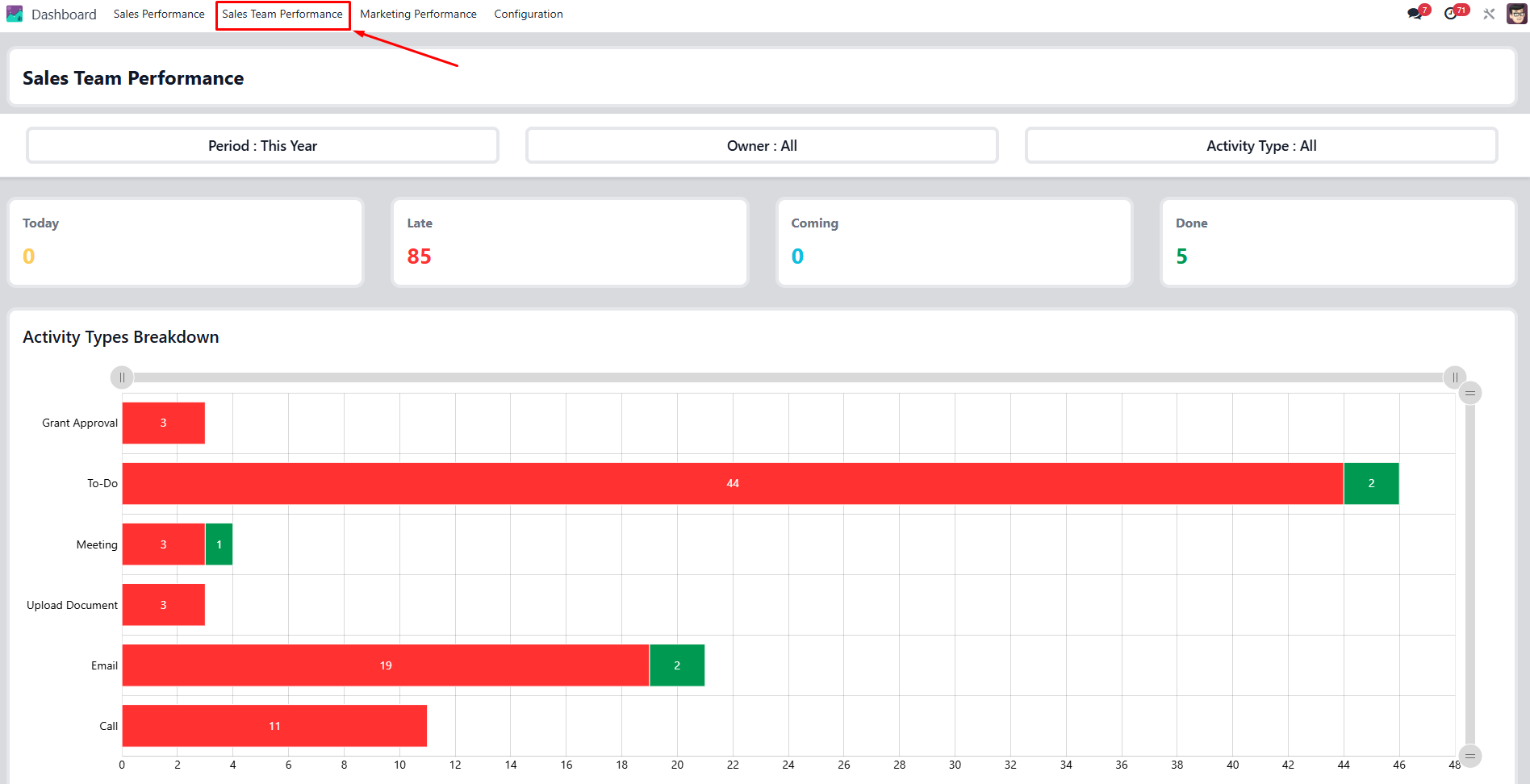
Odoo Sales Team Performance dashboard overview
Management control is the structured process by which managers ensure that an organization’s resources are used effectively and efficiently to achieve the company's objectives, emphasizing alignment between management activities and the broader goals of the organization. It links strategy, execution, and performance measurement into a single control system.
At its core, management control involves:
- Defining clear company goals and specific objectives
- Measuring actual performance using reliable indicators
- Comparing results with targets to identify budget deviations or gaps
- Taking corrective action to realign operations with strategic objectives
This process provides reasonable assurance that the organization is moving in the right direction while remaining compliant with internal controls and regulatory requirements. Internal control focuses on ensuring compliance with processes, procedures, laws, and standards.
Management control processes are closely linked to accounting and handle financial figures on a daily basis.
The Role of the Management Controller
The management controller plays a key role in this system. Rather than being only a financial analyst, the management controller acts as a bridge between strategy and operations. Their responsibilities include:
- Designing data measurement systems and KPIs
- Supporting decision making with accurate, timely information
- Guiding employee behavior through transparent performance metrics
- Coordinating internal reviews and variance analysis
This role is increasingly supported by integrated systems that deliver real-time visibility across departments.
Management Control Systems in Modern Organizations
1. Control Processes Across the Entire Organization
Effective management control systems rely on clearly defined control processes that cover planning, execution, monitoring, and adjustment. These processes are closely linked to a company’s activities and must operate across departments, not in silos. During budget preparation, controllers assess and allocate financial resources to support the company's activities, ensuring that resources are directed toward key operations and projects.
Typical control processes include:
- Strategy planning and budget definition
- Operational execution through projects and workflows
- Monitoring performance via KPIs and dashboards
- Corrective action based on variance analysis
Budgetary controls use annual or rolling five-year budgets as baseline documents to measure financial performance.
When these processes are fragmented across spreadsheets and disconnected tools, management control becomes slow, reactive, and unreliable.
2. Types of Management Control
Most organizations use a combination of control mechanisms, including:
- Financial controls to manage budgets, costs, and profitability
- Bureaucratic controls such as procedures, approvals, and segregation of duties. Bureaucratic controls are essential in management control systems to enhance efficiency and maintain organization.
- Normative controls that guide employee behavior by influencing company culture and informal norms through values and team norms
- Security controls to protect assets, data, and information systems
- Quality control to ensure product quality and compliance with quality standards
An effective control system integrates all of these elements into a coherent framework.
Bring Control into One System
Unify strategy and performance with real-time dashboards and controls
Data Measurement Systems and Key Performance Indicators
1. Measuring Performance with KPIs
Key Performance Indicators are the backbone of management control. They translate strategic objectives into measurable targets that managers and employees understand.
Common KPI categories include:
- Financial performance: margins, cost variances, cash flow
- Operational efficiency: productivity, cycle time, resource utilization
- Quality control: defect rates, rework, compliance indicators
- Project performance: budget adherence, delivery timelines
Balanced scorecard approaches combine financial and non-financial KPIs to give a more complete view of organizational performance.
2. From Big Data to Actionable Insights
Many companies collect large volumes of data but struggle to convert it into decisions. Management control requires data dashboards that present relevant indicators clearly and support fast, informed decision making. Static reports are no longer sufficient, managers need real-time visibility to identify areas requiring immediate action.
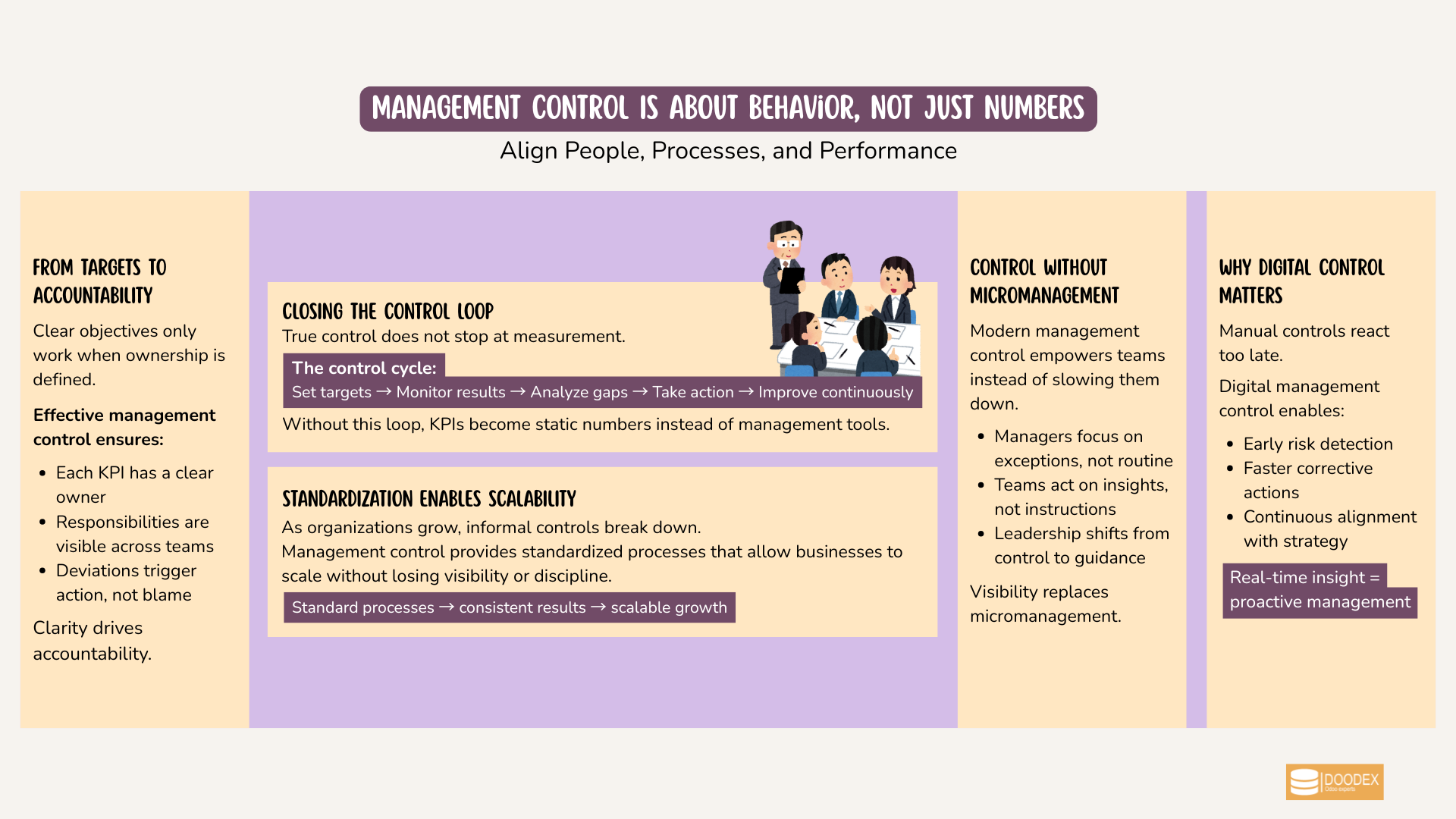
Management control framework connecting strategy, KPIs, and execution
Why Odoo Works as a Management Control System
Odoo is not just an ERP; it is a comprehensive management control system. Its modular architecture allows companies to design control processes that match their organizational structure and strategic priorities.
1. Integrated Control System
One of Odoo’s main strengths is data integration. Financial controls, operational data, and human resources information are stored in a single system. This eliminates inconsistencies, reduces manual reconciliation, and ensures that decision making is based on reliable data.
With Odoo, management control extends across:
- Accounting and financial performance
- Inventory and asset management
- Project management and resource allocation
- Human resources and employee performance
- Quality, compliance, and internal controls
Internal audit plays a key role in verifying compliance with procedures and assessing operational effectiveness within these areas. Regular audits and reviews of controls are necessary to ensure they are operating effectively.
2. Customizable Dashboards and Reporting
Odoo provides flexible dashboards that allow managers to monitor KPIs in real time. These dashboards can be tailored to different roles, from executives focused on strategic objectives to operational managers tracking daily performance.
Management Control Example with Odoo: A Manufacturing Company
1. Company Context
Consider a mid-sized manufacturing company with multiple production lines and departments. The company has clear organizational goals that are closely aligned with the company's objectives: improve profitability, reduce operational risks, and ensure consistent product quality. However, management faces several challenges:
- Limited visibility into actual production costs
- Weak coordination between finance, operations, and projects
- Delayed reporting that hinders timely corrective action
Organizations use management control systems to define objectives and measure results, creating a highly efficient work environment.
2. Problems Before Implementing Odoo
Before adopting Odoo, management control relied heavily on spreadsheets and manual processes. Financial performance was reviewed monthly, making it difficult to react to issues quickly. Resource allocation decisions were based on incomplete data, and quality control problems were often detected too late. In these situations, management would analyze variations such as supply shortages or staffing issues and create goals or plans to address these operational challenges.
Ready to Turn Data into Action?
Implement Odoo to connect KPIs, dashboards, and decision making in one system
Implementing Management Control with Odoo
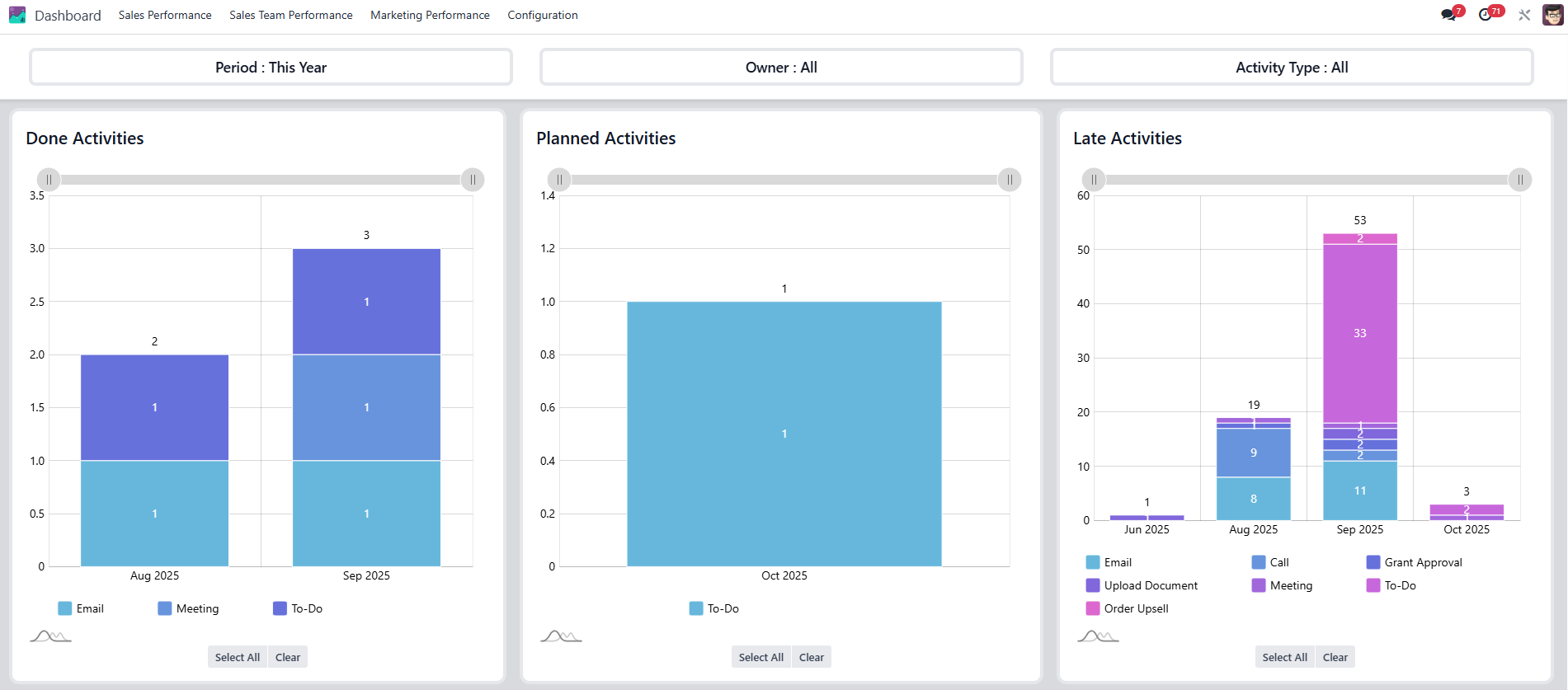
Track activities at Odoo: planned, done, late, and today’s tasks
1. Financial Controls
The company implemented Odoo’s accounting module to establish robust financial controls. Budgets were defined by cost centers and projects, enabling detailed variance analysis. Managers could now monitor financial performance in real time and identify budget deviations early.
2. Control Processes in Operations
Using Odoo’s inventory and manufacturing modules, the company introduced structured control processes for stock and production. Inventory control reduced excess stock and minimized shortages. Production data provided insights into efficiency and product quality, supporting continuous improvement initiatives.
3. Project Management and Resource Allocation
Project management tools in Odoo allowed the company to track time, costs, and progress against plans. This improved resource allocation and helped managers compare planned versus actual performance, a key element of management control.
Best Practices for Management Control
Implementing effective management control requires a strategic approach that aligns the entire organization with its objectives. One of the most important best practices is to establish clear key performance indicators (KPIs) that reflect both strategic and operational goals. These KPIs should be integrated into robust control processes, allowing managers to monitor progress and measure actual performance against targets.
A dedicated management controller should oversee management control activities, ensuring that all departments are working towards the company’s objectives. This role involves coordinating regular internal reviews and audits to identify areas for improvement and mitigate risk before issues escalate. Utilizing advanced data measurement systems is also essential, as they provide accurate, timely feedback that supports informed decision making and resource allocation.
Common Challenges in Management Control
While management control is essential for organizational success, it often comes with significant challenges. One of the most common issues is maintaining regulatory compliance amid evolving standards and requirements. Organizations must also navigate complex bureaucratic controls, which can slow down decision making and hinder agility.
Implementing effective security controls and financial controls is another challenge, especially when trying to balance the need for oversight with operational flexibility. Strategy implementation and project management can be difficult, particularly when actual performance does not align with planned outcomes or when quality control standards are not consistently met.
Establishing a control system that provides reasonable assurance and supports continuous improvement requires ongoing effort. Organizations may struggle with normative controls, such as shaping employee behavior and fostering a culture of quality assurance. Additionally, creating and maintaining effective feedback mechanisms to guide corrective action can be resource-intensive.
Decision Making and Corrective Action
1. Facilitating Decision Making
With integrated dashboards and real-time data, Odoo significantly improved decision making. Managers could identify risks early, evaluate alternative actions, and align decisions with strategic objectives.
2. Corrective Action in Practice
When KPIs indicated underperformance, corrective action was triggered quickly. Examples included reallocating resources, adjusting production schedules, or revising budgets. This closed-loop process ensured that management control was proactive rather than reactive.
✨Pro Tip
Control first, automate second
Define clear objectives, KPIs, and control processes before adding automation.
Strong management control → reliable data → smarter decisions
Continuous Improvement Through Management Control
Management control is not a one-time exercise. Odoo supports continuous improvement by enabling ongoing measurement, analysis, and adjustment. Automated workflows reduce manual effort, while historical data supports benchmarking and long-term strategy implementation.
Over time, the manufacturing company achieved:
- Improved profitability
- Better compliance and risk mitigation
- Higher employee accountability and engagement
- Stronger alignment between strategy and execution
Future of Management Control
The landscape of management control is rapidly evolving, driven by advances in technology and the increasing availability of big data. In the future, management control systems will be more reliant on real-time data dashboards and advanced analytics, enabling managers to quickly identify areas for improvement and make necessary adjustments to achieve company goals.
Concurrent control mechanisms will become more prevalent, allowing organizations to respond rapidly to changes in the business environment. Strategic vision and planning will play a greater role, as companies seek to embed continuous improvement and quality assurance into their culture. The use of balanced scorecard methodologies will help organizations align performance measurement with strategic objectives, ensuring that every part of the company is working towards common goals.
To stay competitive, management controllers will need to develop expertise in data analysis, strategic planning, and performance measurement. Embracing new technologies and approaches will be essential for creating robust management control systems that facilitate decision making and drive organizational success.
Take Control with Odoo
Turn management control into real-time insight and smarter decisions with Odoo
Conclusion
A strong management control system is not about adding more reports or tightening supervision it is about creating clarity, discipline, and alignment between strategy, operations, and results. A practical management control example shows that when objectives are clearly defined, performance is measured consistently, and corrective action is taken early, organizations gain control over both day-to-day execution and long-term direction. This article demonstrates that management control becomes significantly more effective when supported by an integrated system rather than disconnected tools, combining financial controls, operational monitoring, and project management into a single platform, and Odoo enables management control across the entire organization.
Managers gain real-time visibility into actual performance, employees better understand expectations, and decisions are based on facts rather than assumptions. Most importantly, management control with Odoo is not static, as it supports continuous improvement by allowing organizations to learn from data, adjust processes, and refine strategy over time. Whether the goal is improving financial performance, strengthening compliance, optimizing resource allocation, or guiding employee behavior, a well-designed management control system turns strategy into measurable, actionable outcomes and shifts from a reporting obligation into a strategic advantage that drives sustainable business performance.
FAQs
A management control example shows how an organization uses KPIs, financial controls, and corrective action to align operations with strategic objectives.
Odoo integrates accounting, operations, projects, and HR into a single control system with real-time dashboards and reporting.
No. SMEs can also benefit from management control by using scalable systems like Odoo to structure decision making and resource allocation.
KPIs measure actual performance against targets and guide corrective action and continuous improvement.
By providing accurate, timely data and clear performance indicators, management control reduces uncertainty and supports informed decisions.
Management control systems incorporate internal controls and audit trails that support regulatory compliance and risk management.
An experienced Odoo partner ensures that management control systems are designed around real business processes, not just software features.