
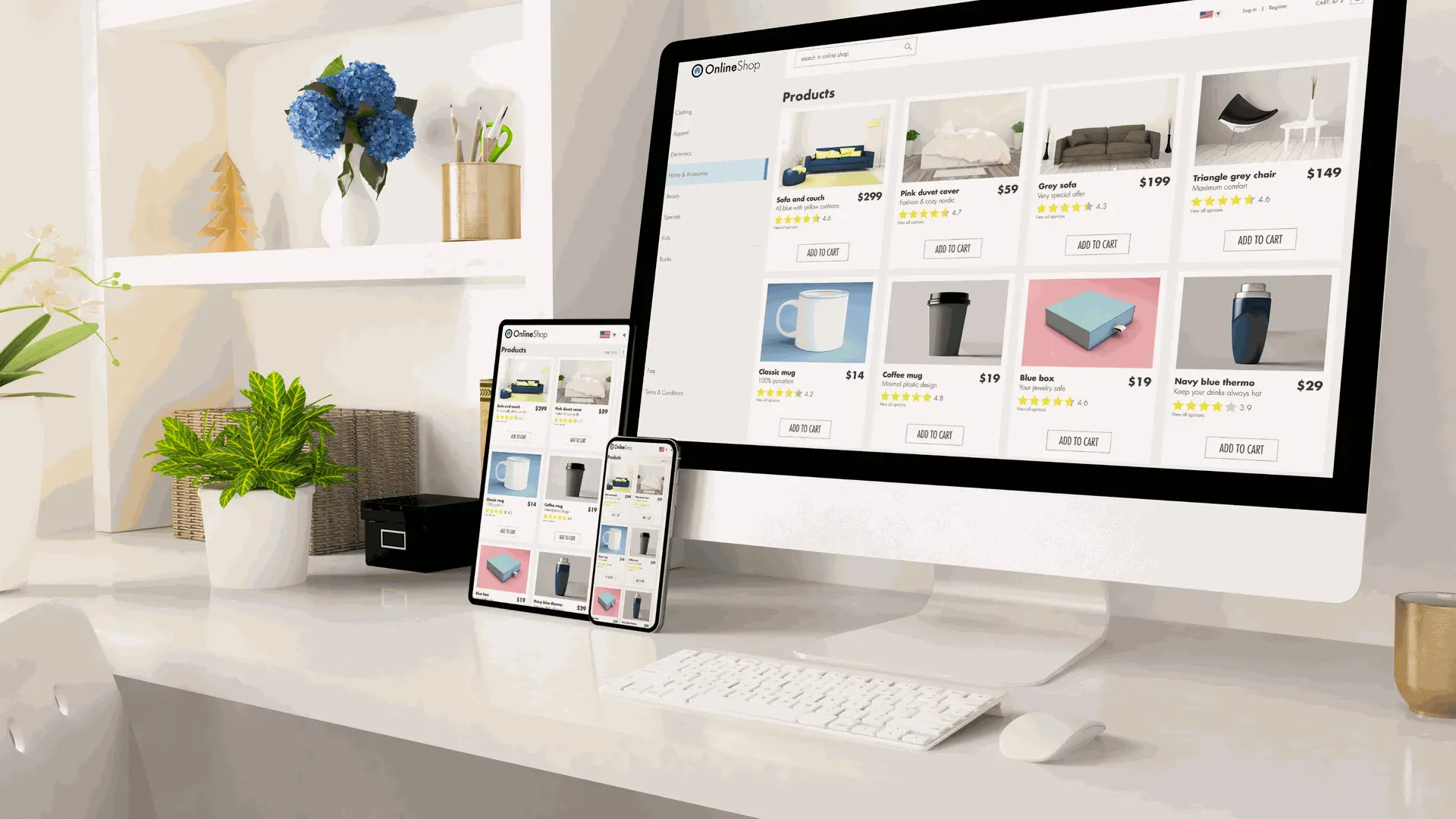
Buying decisions today are driven by flexibility, not one-size-fits-all products. Customers want solutions that match their needs and budgets without paying for features they don’t use, which has led to the rise of optional purchase products. This approach allows businesses to offer a core product with essential value, while optional features add customization and enhance the overall experience. By giving customers control over what they pay for, optional purchase products support modern pricing strategies across industries such as SaaS, manufacturing, airlines, and enterprise software.
Key Takeaways
- Optional purchase products let customers pay only for features they need, instead of fixed bundles.
- The core product works independently, while optional items enhance or personalize the experience.
- This approach supports flexible pricing, upselling, and broader customer reach.
- Choice is the key difference optional products are never mandatory like captive products.
- Clear communication and pricing are essential to avoid customer confusion.
- ERP systems such as Odoo help manage optional products consistently at scale.
- Doodex Modules simplify optional product management by integrating configuration and pricing directly into purchase workflows.
Key Takeaways
What Is an Optional Purchase Product?
Optional Purchase Product vs Other Pricing Models
1. Optional Product Pricing Model
2. Captive Product Pricing
3. Product Line Pricing
How Optional Purchase Products Work in Practice
Customer Demand and Choice
Key Benefits of Optional Purchase Products
1. Benefits for Customers
2. Benefits for Businesses
Drawbacks and Challenges to Consider
Implementing Optional Purchase Products Successfully
1. Identify the Core Product
2. Select Relevant Optional Add-Ons
3. Set a Balanced Pricing Strategy
4. Communicate Transparently
Examples of Optional Products Across Industries
1. SaaS and Software
2. Consumer Electronics
3. Automotive Industry
Optional Purchase Products in ERP and Odoo Environments
How Doodex Supports Optional Purchase Product Management
See How Doodex Modules Support Optional Purchase Products in Odoo
1. Optional Products in Purchase Orders
2. Simple Optional Product Selection
3. Automatic Vendor-Based Pricing
Conclusion
FAQs
What Is an Optional Purchase Product?
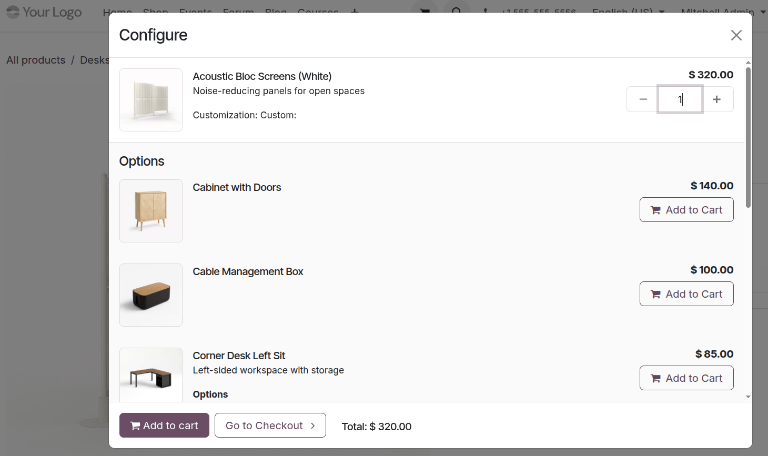
Optional products during checkout in Odoo eCommerce
An optional purchase product is a product, feature, or service that complements a primary product but is not required for the core product to function as intended. Customers may choose to add it during or after the initial purchase, depending on their preferences, budget, and perceived value.
In simple terms:
- The core product delivers essential functionality.
- The optional purchase product enhances, extends, or personalizes that functionality, often through extra features.
- The decision to buy the optional product always belongs to the customer.
This concept is closely linked to optional product pricing, where the base offering is attractively priced, and additional features, accessories, or complementary products are offered separately. Optional purchase products can take many forms, such as:
- Additional features or premium upgrades
- Accessory and complementary products
- Product's accessories, which can boost sales and provide customization options by allowing customers to tailor the main product to their needs
- Extended warranties or service contracts
- Extra capacity, storage, or usage limits
- Add-ons in subscription services
Common examples of optional product pricing include printers with extra features like wireless printing, razors with optional blade refills, and video game consoles paired with complementary products such as additional controllers or accessories. Similar strategies are also seen in cars with optional sunroofs or navigation systems.
Optional purchases can also save time or effort, such as pre-assembled furniture or express shipping, or provide peace of mind, like extended warranties or accidental damage protection plans.
The defining characteristic is choice. Unlike mandatory components, optional purchase products are never required for the essential product to function, making them fundamentally different from captive products.
Optional Purchase Product vs Other Pricing Models
Understanding the optional purchase product concept becomes clearer when compared with other common pricing models. The optional pricing strategy involves setting a clear set price for the core product, while offering optional add-ons or features for customers who want them. This approach allows businesses to upsell and provide customization, giving customers flexibility in their purchase decisions.
Optional Product Pricing Model
The optional product pricing model centers on selling a core product at a relatively low price point to attract customers, then increasing revenue through optional upgrades and add-ons. Optional purchase products are the building blocks of this model. The optional product pricing strategy is widely used in industries like automotive, where car manufacturers offer a base model with the option to add luxury features such as a sunroof or premium sound systems.
Key characteristics:
- Low entry price
- Upselling and cross-selling through optional features
- Pay-extra-only-if-needed logic
- Strong focus on perceived value
This model appeals to diverse customer segments, from budget-conscious buyers to premium customers seeking advanced functionality.
Captive Product Pricing
Captive product pricing takes a more restrictive approach. In this model, the secondary product is essential for the core product to function. Companies often sell the main product at a cheaper price to attract customers and lock them into their ecosystem.
Classic examples include:
- Printer ink cartridges: Printers are often sold at a low price because manufacturers rely on ink sales for profit, knowing customers will need to buy expensive ink cartridges to use them.
- Razor blades
- Certain proprietary consumables
The key difference is freedom of choice. With captive pricing, customers must make additional purchases. With optional purchase products, customers can decide whether the extra cost is worth it.
Product Line Pricing
Product line pricing offers multiple versions of a product at different price levels. While it provides options, it often lacks the granular customization of optional purchase products. Customers choose one product version rather than building their own configuration.
How Optional Purchase Products Work in Practice
Optional purchase products follow a predictable customer journey:
- Attract customers with a competitively priced basic product.
- Present optional add-ons that clearly enhance value.
- Allow customers to pay extra only for features they want.
- Increase average order value through optional upgrades rather than forced bundles.
Optional purchase products are designed to encourage consumers to personalize their experience by selecting add-ons or upgrades that fit their needs, which can boost revenue for businesses.
This approach reduces purchase risk and friction. Customers feel empowered rather than pressured, which improves trust and satisfaction. From a business perspective, it supports both revenue growth and long-term customer relationships. Optional services like gift wrapping or premium support allow for tailoring the purchase experience to individual preferences.
Optional feature pricing also enables flexible cross-selling strategies. For example, a customer may initially buy only the basic product but later add premium features as their needs grow.
Looking to adapt optional product pricing in Odoo?
Doodex customizes Odoo to align options, pricing logic, and customer journeys
Customer Demand and Choice
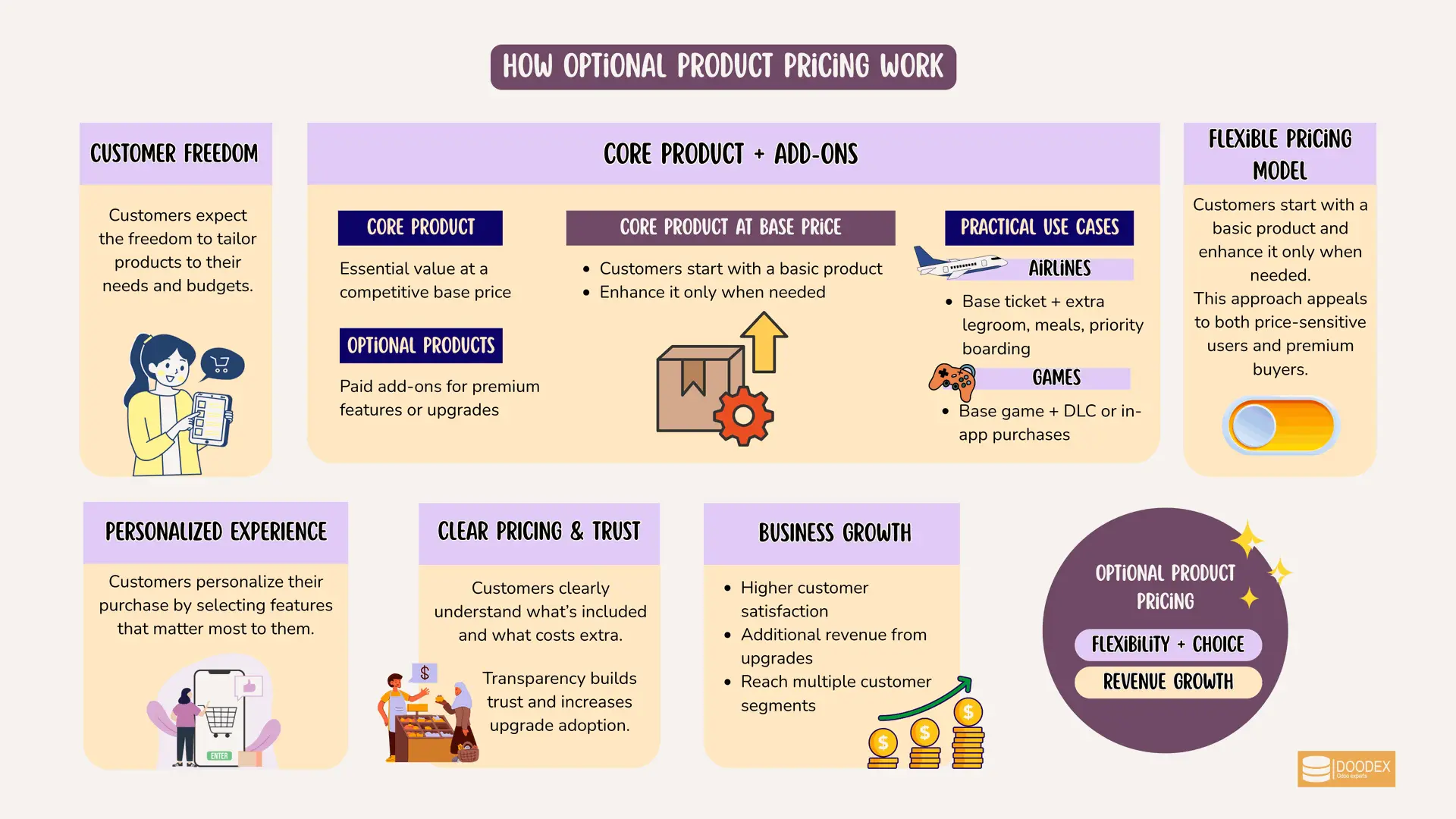
Optional product pricing driven by customer demand and choice
Optional product pricing is built around understanding customer demand and giving buyers the freedom to choose what fits their needs and budgets. By offering a core product at a competitive base price and adding optional features as upgrades, businesses can appeal to both price-sensitive customers and those willing to pay more for premium value. This flexible approach allows customers to start simple and personalize their purchase over time.
To apply this strategy effectively, companies must clearly distinguish between essential and optional features. This helps set the right base price, identify high-value add-ons, and present options that align with different customer segments, as seen in industries like airlines, gaming, and SaaS. Transparency plays a key role customers need to understand exactly what is included and what costs extra to build trust and encourage upgrades.
Beyond pricing flexibility, optional product pricing also provides valuable insights. By tracking which add-ons customers choose most often, businesses can refine their offerings, improve relevance, and support long-term revenue growth and customer loyalty.
Key Benefits of Optional Purchase Products
Benefits for Customers
- Customization and choice: Customers tailor purchases to their needs.
- Budget flexibility: Lower upfront costs reduce barriers to entry.
- Risk reduction: Buyers can test the core product before committing to upgrades.
- Higher satisfaction: Paying only for relevant features improves perceived fairness.
Benefits for Businesses
- Revenue growth: Optional purchases increase lifetime value.
- Broader market appeal: Attracts both price-sensitive and premium customers.
- Higher perceived value: Optional enhancements frame premium features as valuable upgrades.
- Scalable pricing strategy: Products grow with customer demand.
When implemented correctly, optional purchase products create a win–win dynamic: customers gain control, and businesses gain flexibility.
Drawbacks and Challenges to Consider
Despite their advantages, optional purchase products introduce several challenges:
- Customer confusion: Too many options can overwhelm buyers.
- Loss leader risk: Pricing the core product too low can hurt margins.
- Brand dilution: Poorly designed add-ons can weaken premium positioning.
- Lower base LTV: If upselling fails, revenue may stagnate.
- Integration complexity: Optional products must integrate seamlessly with the core product.
Clear communication, thoughtful pricing, and operational discipline are essential to avoid these pitfalls.
Implementing Optional Purchase Products Successfully
Identify the Core Product
Start with a clearly defined essential product that delivers standalone value. Its price should reflect fair market value while remaining accessible.
Select Relevant Optional Add-Ons
Optional products should:
- Be complementary
- Solve real customer problems
- Align with brand positioning
- Offer tangible value
Set a Balanced Pricing Strategy
Optional feature pricing must feel justified. Prices that are too high discourage adoption, while prices that are too low erode perceived value. Optional upgrades should offer perceptible value to justify a higher price to customers.
Communicate Transparently
Marketing should clearly explain:
- What is included in the base product
- What optional features add
- Who benefits most from each upgrade
Transparency reduces confusion and builds trust.
Want a smooth optional product strategy in Odoo?
Doodex develops Odoo features aligned with real business workflows
Examples of Optional Products Across Industries
SaaS and Software
SaaS companies frequently use optional purchase products:
- Advanced analytics modules
- Additional user seats
- Premium support plans
- Integration capabilities
SaaS platforms can boost revenue by offering extra features, cross-platform solutions, and additional plugins as optional purchase products, often within the same company ecosystem. This approach allows customers to enhance the core product and select add-ons that best fit their needs, while companies like Adobe leverage their suite of products to increase sales and customer retention.
This model supports subscription services that scale with customer growth.
Consumer Electronics
Smartphone companies sell devices at a base price, then offer optional accessories such as cases, screen protectors, wireless chargers, and extended warranties. A phone company (mobile service provider) may offer phones at a subsidized price when customers sign a service contract, relying on customer retention for ongoing revenue. A product’s accessories, such as screen protectors or phone straps, are optional add-ons that enhance the core product. In consumer electronics, the choice between optional and mandatory purchases impacts cost, customization, and perceived value.
Automotive Industry
Car manufacturers offer a base model and optional features like leather seats, advanced navigation, premium sound systems, and service contracts. Optional product pricing can enhance a premium product by allowing customers to personalize their vehicles with upgrades or features that add value, increasing both revenue and customer satisfaction.
Optional Purchase Products in ERP and Odoo Environments
As optional purchase products grow in complexity, managing multiple products manually becomes risky. Businesses must track:
- Product configurations
- Purchasing rules
- Inventory implications
- Pricing consistency
Optional products often include useful accessories that are commonly selected by other customers, making consistency and accuracy even more critical. Without proper systems, optional products can cause operational errors, billing issues, and customer dissatisfaction. This is where ERP platforms such as Odoo become essential, enabling structured management of optional products across purchasing, inventory, and sales workflows.
✨Pro Tip
Configure optional purchase products inside purchasing workflows, not as manual add-ons
When optional products are selected directly in purchase orders, vendor pricing, inventory impact, and product configurations stay consistent across the ERP.
How Doodex Supports Optional Purchase Product Management
Doodex provides a dedicated Optional Purchase Product module available on the Odoo App Store, designed to simplify how businesses manage optional products within Odoo. The module called Purchase Product Optional enhances the standard Odoo purchasing workflow by adding a product configurator directly into purchase orders, allowing optional products and variants to be selected with ease.
Key benefits include:
- Structured configuration for multiple products, optional items, useful accessories, and product variants directly within purchase orders.
- Vendor-based dynamic pricing, so vendor-specific costs are applied automatically for configured options.
- Better visibility into optional products frequently chosen by other customers.
- Improved purchasing and inventory alignment across ERP workflows.
- Reduced manual errors through integrated product configuration and transparent pricing.
- Clear visibility into optional feature pricing and associated cost implications.
- Better control over purchasing strategies, with seamless Odoo integration that does not disrupt existing workflows.
By embedding optional purchase products directly into ERP workflows, businesses can scale their offerings without adding operational complexity and ensure optional products are managed consistently from procurement through to sales.
See How Doodex Modules Support Optional Purchase Products in Odoo
To help businesses better understand how optional purchase products work in real purchasing scenarios, the following examples show how Doodex modules enhance this functionality inside Odoo. The goal is to make purchasing more flexible, clear, and easier to manage without adding complexity for users.
Optional Products in Purchase Orders
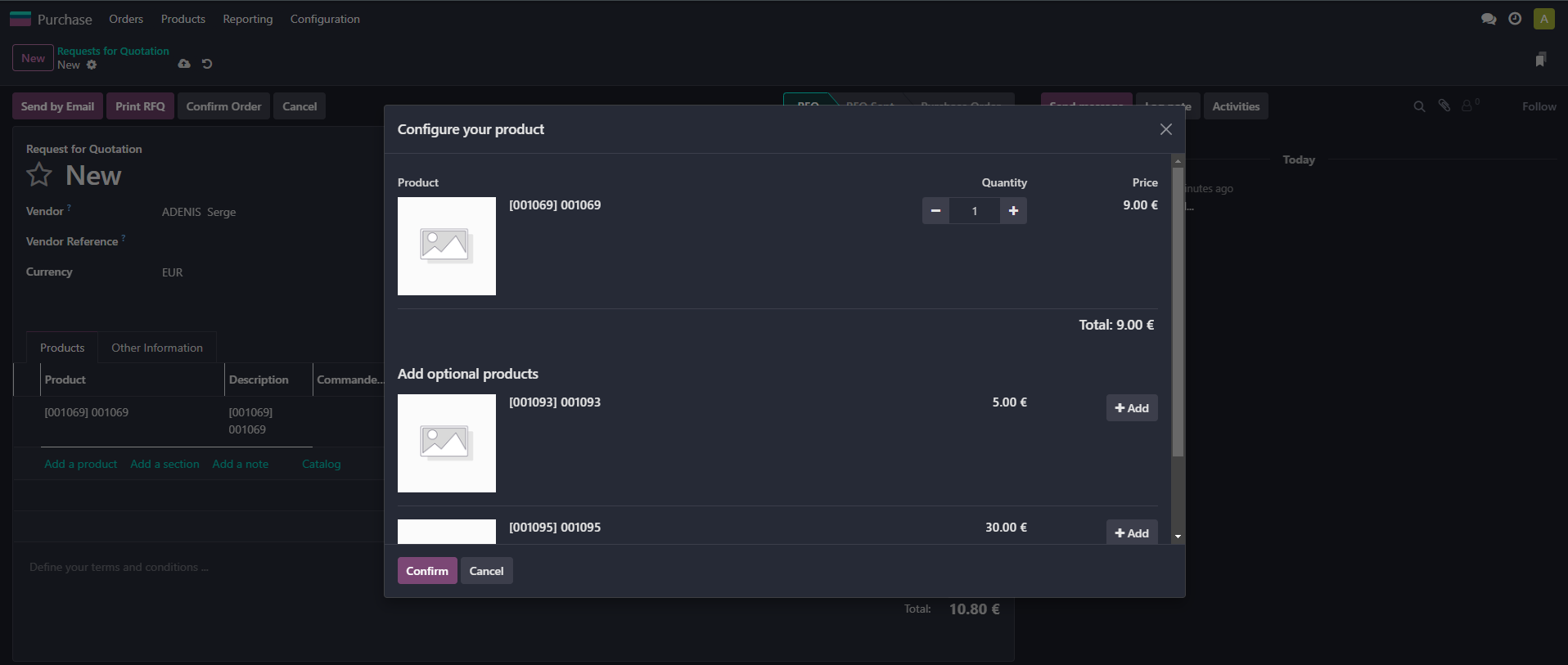
Shows the Product Configurator for optional products in Purchase (Odoo module by Doodex)
When a main product is selected in a purchase order, related optional products automatically appear. With Doodex modules, buyers can clearly see which additional items are available and decide whether they are needed before confirming the order. This helps prevent missed add-ons and improves purchasing accuracy.
Simple Optional Product Selection
The product configuration pop-up allows users to add or remove optional products with just a few clicks. Doodex modules keep this interface simple and user-friendly, so purchasing teams can make quick decisions without confusion or extra steps.
Automatic Vendor-Based Pricing
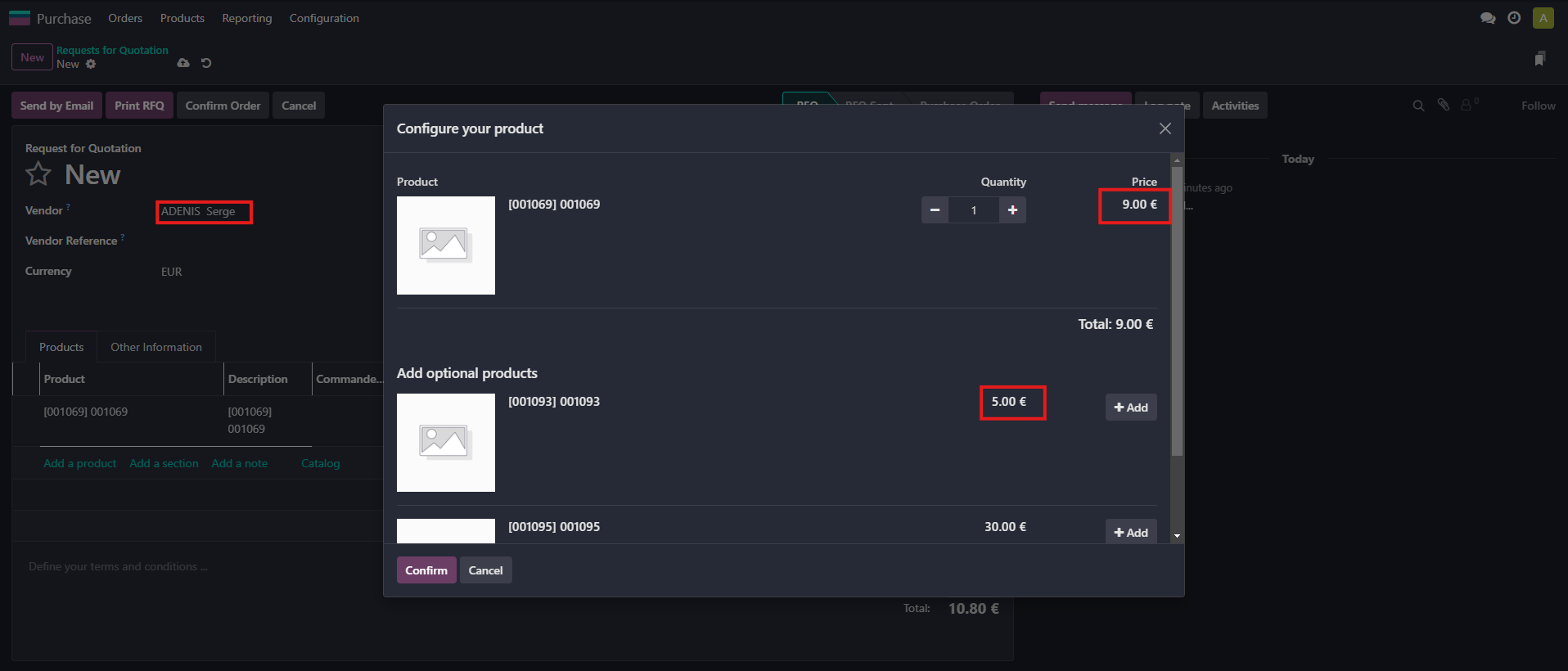
Prices follow the selected vendor’s supplier info; otherwise, the standard price is used
Optional product prices can vary depending on the selected vendor. Doodex modules handle this automatically by applying vendor-specific pricing rules, ensuring that costs are always accurate and aligned with supplier agreements without manual price adjustments.
By showing optional products directly within the purchasing workflow, Doodex modules help businesses better understand what they are buying, how much it costs, and which options are available. These visual examples demonstrate how optional purchase products can be managed smoothly in day-to-day operations.
More than just an interface enhancement, Doodex modules are designed to support scalable purchasing processes. They help reduce errors, improve transparency, and give businesses better control over optional purchase product management as operations grow.
Simplify optional product selection in Odoo purchasing?
See how this module supports clearer configuration and pricing
Conclusion
Managing purchasing and optional product processes often requires more than standard ERP configuration. While Odoo provides a flexible foundation, real efficiency comes from tailoring the system to actual business workflows, pricing logic, and operational needs.
With Doodex services, Odoo is customized to support clearer purchasing processes, improved transparency, and scalable operations. This helps businesses maintain control, reduce errors, and ensure their ERP system continues to support long-term growth.
FAQs
An optional purchase product is an add-on, feature, or service that enhances a core product but is not required for its basic functionality.
Optional purchase products are optional by choice, while captive products are mandatory for the main product to work.
Add-ons are a type of optional purchase product, but the term also includes upgrades, accessories, and optional services.
They increase average order value and customer lifetime value through upselling and cross-selling.
SaaS, airlines, automotive, consumer electronics, mobile games, and hospitality benefit significantly.
Yes. Lower upfront prices reduce commitment risk and encourage trial.
Using ERP systems like Odoo with dedicated modules helps automate configuration, pricing, and purchasing workflows.