
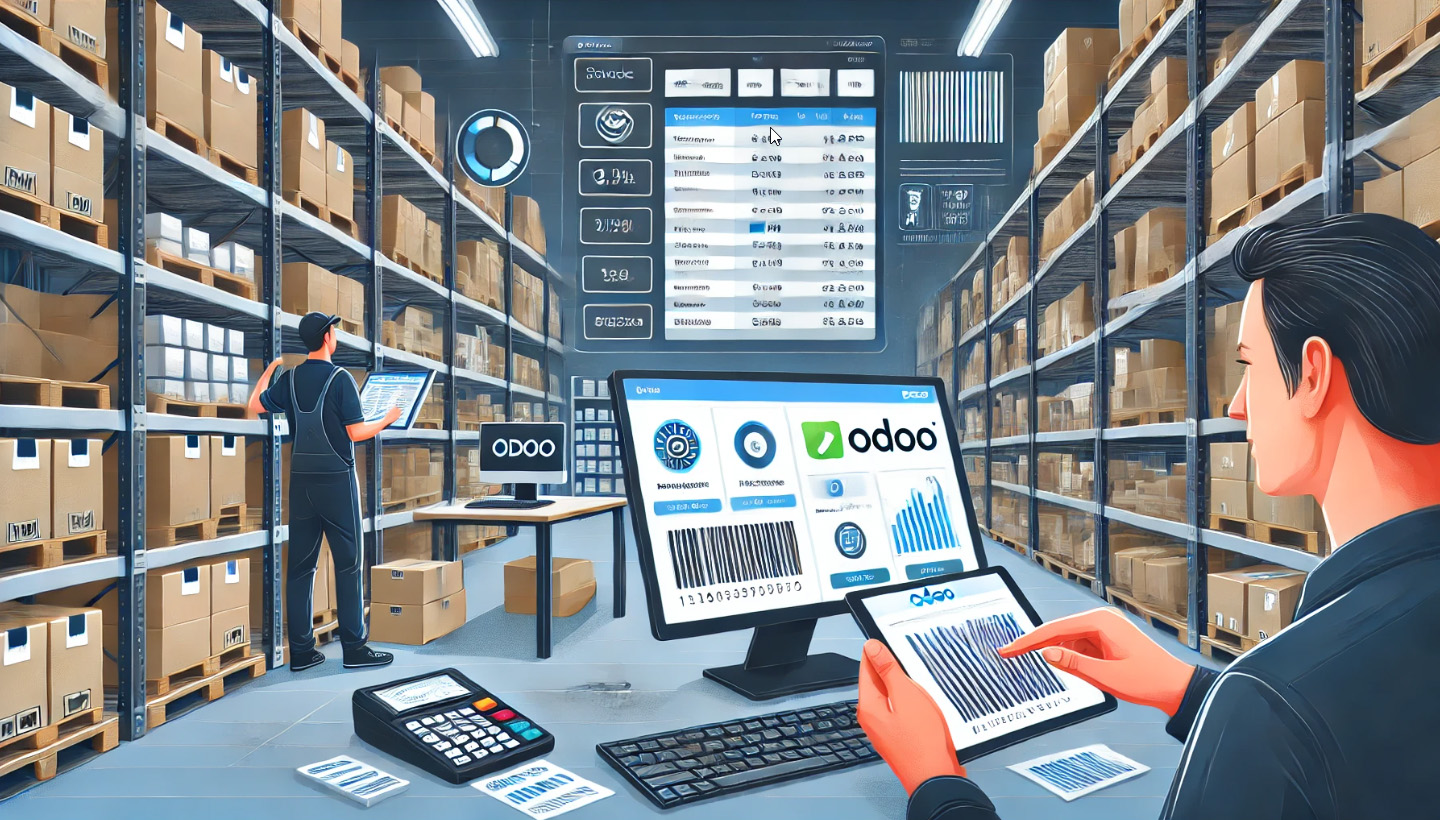
Inventory is one of the most sensitive assets in any business that handles physical goods. Stock inaccuracies quickly translate into delayed deliveries, excess costs, and dissatisfied customers. This is why the role of a stock manager in Odoo is no longer limited to counting products, but becomes a strategic function that connects warehouse operations, purchasing, sales, and finance within a single inventory management system. Stock management is a critical component of inventory control in Odoo, ensuring that all stock movements are efficiently tracked and managed.
Odoo provides a comprehensive environment where stock managers can monitor stock levels in real time, automate replenishment, and maintain full control over inventory movements across warehouses and locations. Optimizing stock levels is essential for efficient storage and inventory control, helping businesses avoid overstocking or stockouts. With the right configuration and discipline, Odoo ERP turns inventory into a reliable, measurable, and scalable business process. Odoo also delivers real time insights, enabling stock managers to make informed decisions and improve overall efficiency.
Key Takeaways
- A stock manager in Odoo plays a strategic role in inventory and business operations
- Odoo provides real time inventory tracking, automated reordering, and detailed reporting
- Multi warehouse management supports scalable growth
- Inventory valuation in Odoo improves financial accuracy and control
- Integrated workflows reduce costs, errors, and operational friction
Key Takeaways
What Is a Stock Manager in Odoo
Core Inventory Management Responsibilities
1. Inventory Management Processes
2. Storage Locations and Warehouse Operations
Odoo Inventory Management System Overview
Key Features for a Stock Manager in Odoo
1. Real Time Inventory Tracking
2. Automated Reordering
3. Multiple Warehouses and Multi Warehouse Management
Inventory Valuation in Odoo
Inventory Reporting and Data Analysis
Daily Stock Manager Workflow in Odoo
Initial Setup Best Practices
Challenges of Traditional Inventory Methods
Product Master Data Management in Odoo
Mobile Accessibility and Scalability
Excel vs Stock Manager in Odoo
How Odoo Supports Business Operations
Industries That Benefit from Odoo
Doodex as Your Odoo Inventory Partner
Conclusion
FAQs
What Is a Stock Manager in Odoo
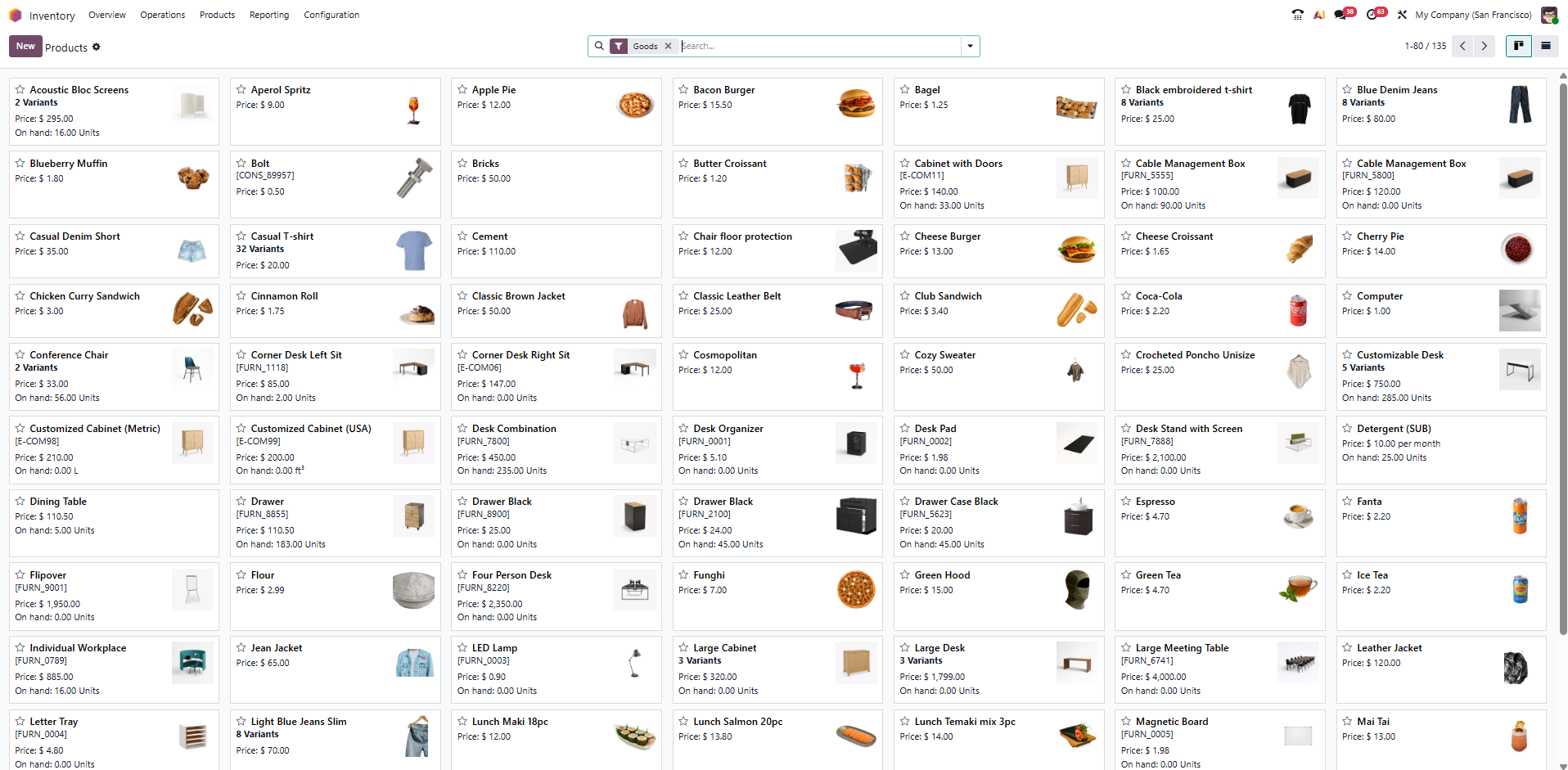
Odoo stock manager inventory dashboard
A stock manager in Odoo is responsible for overseeing all inventory-related activities using the Odoo Inventory module. This role combines operational execution with analytical oversight. The stock manager ensures that products are available in the right quantities, at the right locations, and at the right time, while minimizing waste and excess stock.
Unlike manual or spreadsheet-based systems, inventory management in Odoo is built on real time updates. Every incoming shipment, internal transfer, manufacturing order, or outgoing delivery updates stock quantities instantly. This gives the stock manager real time visibility across warehouse operations and business processes.
Core Inventory Management Responsibilities
1. Inventory Management Processes
Stock managers use Odoo for stock management and to monitor stock levels continuously. They track inventory movements, prevent stockouts, and avoid overstocking by analyzing demand patterns and consumption trends. Forecasting tools in Odoo use historical sales data to predict future demand, which aids in purchasing decisions. These inventory management processes help streamline operations and support informed decisions across departments.
2. Storage Locations and Warehouse Operations
Odoo supports detailed warehouse management through storage locations and virtual locations. Stock managers can organize warehouses logically, define picking and packing zones, and control internal transfers between locations. Odoo also enables stock managers to efficiently manage outgoing shipments, ensuring timely and accurate delivery to customers. This structure improves operational efficiency and reduces handling time.
Odoo Inventory Management System Overview
The Odoo Inventory module acts as a central hub for all stock-related activities. It supports barcode scanning, serial number tracking, lot numbers, and expiry dates. These advanced features significantly reduce human errors and improve traceability, especially for industries that require strict quality control.
Real time inventory tracking ensures that stock data is always accurate. Whether products are received from suppliers, moved internally, or shipped to customers, inventory movements are recorded instantly.
Build Better Inventory Control with Odoo
See how Doodex implements Odoo inventory for accurate, real-time stock control
Key Features for a Stock Manager in Odoo
1. Real Time Inventory Tracking
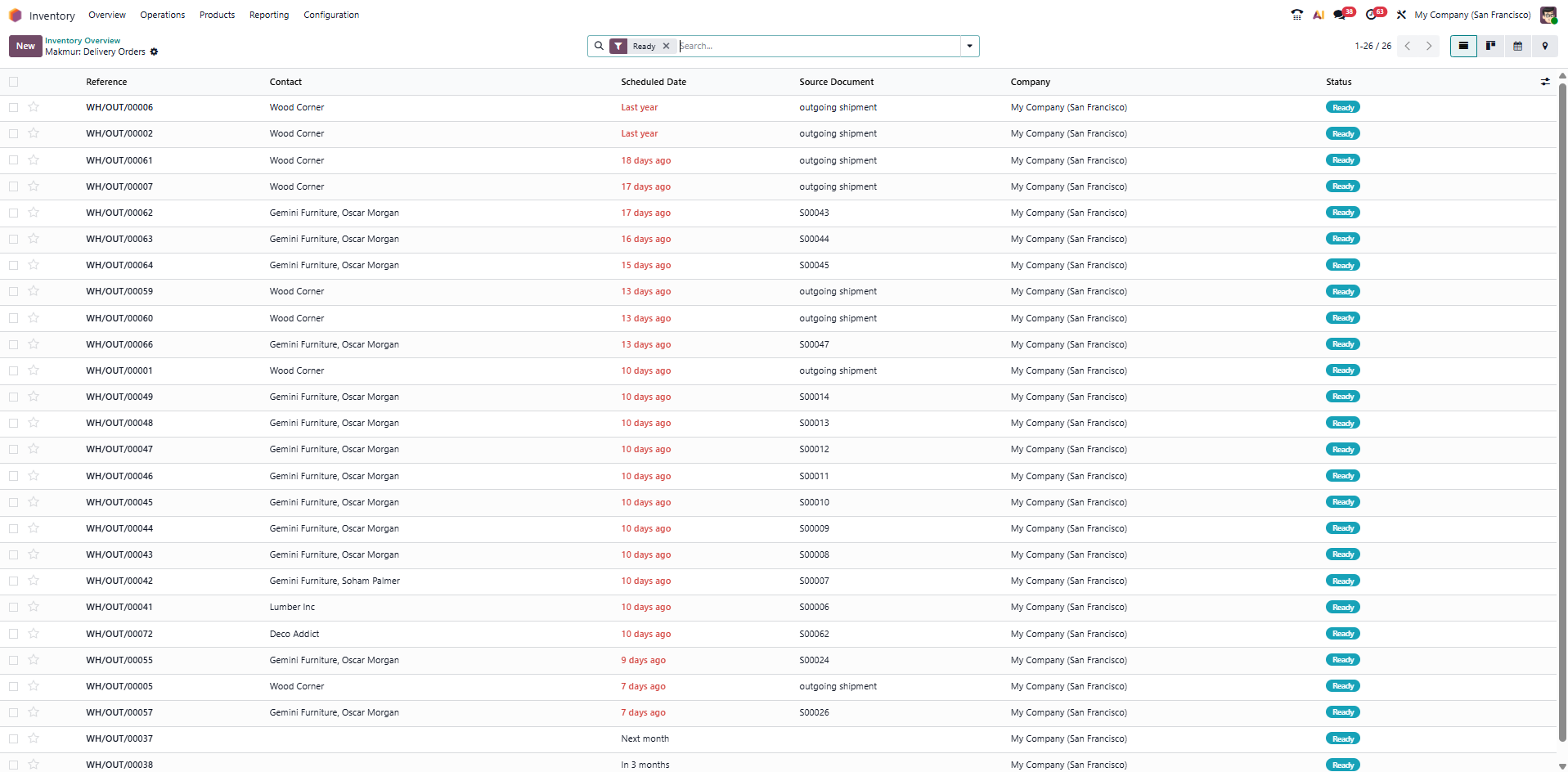
Real-time inventory tracking in Odoo Inventory for stock manager monitoring outgoing shipments
Real time inventory tracking is one of the strongest advantages of Odoo inventory management. Real time insights provided by Odoo enable stock managers to make faster, more informed decisions, improving efficiency and customer satisfaction. Stock managers can monitor stock levels, product movements, and warehouse operations as they happen. This real time visibility supports faster operations and better coordination with sales and manufacturing.
2. Automated Reordering
Odoo allows stock managers to configure automated reordering rules based on minimum and maximum stock levels. When quantities fall below a defined threshold, the system can automatically generate purchase orders or manufacturing orders. Automated reordering helps reduce waste, avoid emergency purchases, and maintain optimized stock levels.
3. Multiple Warehouses and Multi Warehouse Management
For businesses operating across several locations, Odoo supports multiple warehouses and multi warehouse management from a single interface. Stock managers can balance stock across warehouses, manage internal transfers, and open new warehouses without disrupting existing operations. This flexibility supports evolving business needs and growth.
Inventory Valuation in Odoo
Inventory valuation plays a critical role in both financial accuracy and operational decision-making. Odoo supports multiple valuation methods, including FIFO, AVCO (average cost), and standard price. Stock managers work closely with finance teams to ensure that inventory valuation aligns with accounting policies and business objectives.
With real time inventory valuation, stock movements immediately impact financial records. This provides clear insights into stock value, cost of goods sold, and margins, enabling better control over business operations.
Inventory Reporting and Data Analysis
Inventory reporting in Odoo provides detailed reports that help stock managers identify trends and inefficiencies. Available reports include stock moves history, inventory valuation, stock aging, and inventory adjustments. These detailed reports support data-driven decisions and continuous improvement.
By analyzing inventory reporting data, stock managers can identify slow-moving items, optimize stock quantities, and improve warehouse operations. This analytical capability transforms inventory from a reactive task into a proactive management function.
Daily Stock Manager Workflow in Odoo
A typical day for a stock manager in Odoo involves managing incoming shipments, validating internal transfers, and preparing outgoing deliveries. Advanced picking strategies in Odoo include wave, cluster, and batch picking to increase warehouse efficiency and save time by streamlining order picking processes. Manufacturing orders are tracked to ensure components are available when needed, and serial numbers or batch numbers are assigned accurately.
Cycle counting is another important activity. Odoo supports cycle counting by allowing inventory frequency settings per location. This ensures that physical stock counts match system records without requiring full warehouse shutdowns.
Deeper Inventory Insights with Odoo
Complete yout inventory workflows with clear product movement history
Initial Setup Best Practices
A successful stock manager in Odoo starts with a solid initial setup. This includes configuring product categories, defining storage locations, selecting valuation methods, and enabling barcode scanning. Automated reordering rules and routes should be defined early to support seamless operations.
Proper initial setup reduces long-term complexity and ensures that the inventory management system scales smoothly as the business grows.
Challenges of Traditional Inventory Methods
Traditional inventory management methods, such as spreadsheets or paper-based systems, often create significant challenges for businesses. Without real time visibility, it becomes difficult to accurately track stock levels, monitor stock movements, or maintain up-to-date inventory valuation. These manual processes are prone to human errors, leading to discrepancies that can result in stockouts, overstocking, and delayed order fulfillment. Such inefficiencies not only disrupt business operations but also impact customer satisfaction and overall operational efficiency.
Managing inventory across multiple warehouses or locations is especially problematic with traditional methods, as they lack the integration and coordination needed for seamless operations. Inventory reporting is often delayed or incomplete, making it hard for businesses to identify trends or make informed decisions. In contrast, an inventory management system like Odoo provides a comprehensive solution that streamlines operations, delivers real time updates, and reduces the risk of costly mistakes. By leveraging Odoo, businesses can ensure accurate stock levels, efficient stock movements, and improved inventory reporting across all warehouses and locations.
Product Master Data Management in Odoo
Accurate product master data is the foundation of effective inventory management. Odoo enables businesses to build a centralized product catalog, capturing essential details such as product codes, descriptions, barcodes, and vendor information. This robust product master data management ensures that all inventory management processes from purchasing to sales are based on reliable, up-to-date information.
Odoo’s inventory module also supports advanced quality control by allowing businesses to track product specifications, certifications, and compliance requirements. With the ability to manage virtual locations and multiple warehouses, businesses can organize storage locations efficiently and maintain seamless operations across all sites. By keeping product data accurate and accessible, Odoo helps reduce errors, optimize inventory flows, and boost overall efficiency in warehouse operations and sales.
Mobile Accessibility and Scalability
Odoo’s mobile accessibility empowers warehouse teams to perform key inventory management tasks directly from their mobile devices. Staff can scan barcodes, validate deliveries, and record stock movements on the go, with real time updates instantly reflected in the inventory management system. This capability not only enhances operational efficiency but also ensures that stock data remains accurate and up-to-date at all times.
As businesses expand, Odoo’s scalability allows the inventory management system to grow alongside evolving business needs. Whether adding new warehouses, launching additional product lines, or managing more complex workflows, Odoo adapts seamlessly. The system supports multiple companies and locations, enabling businesses to effectively manage inventory across diverse operations. Features like cycle counting further help monitor stock levels and maintain accurate inventory records, supporting seamless operations and informed decision-making as the business evolves.
Excel vs Stock Manager in Odoo
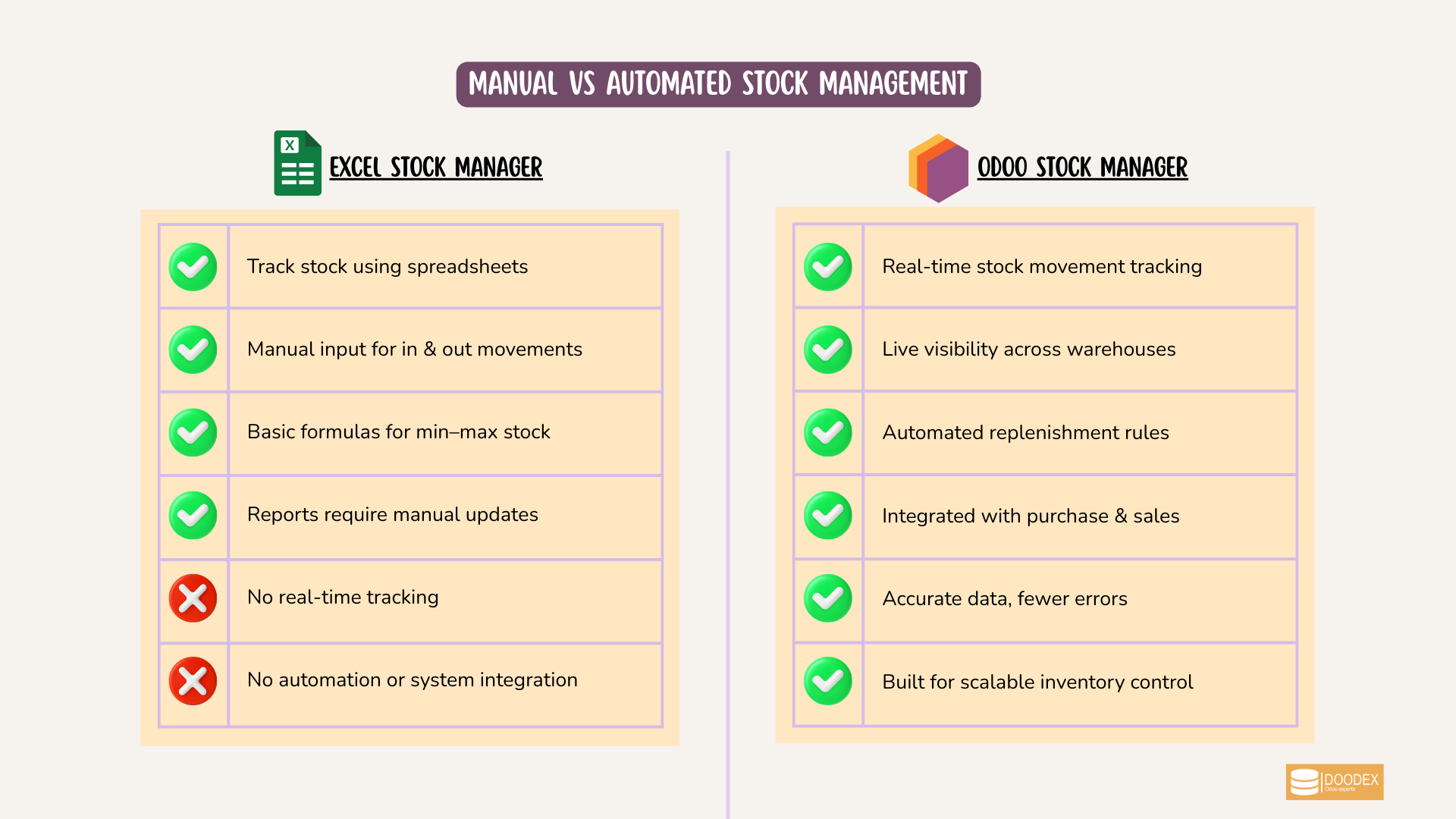
Manual vs Automated Stock Management
Many businesses begin with Excel to manage inventory. While Excel can handle basic stock tracking, it lacks real time updates, integration with other modules, and automation. Manual data entry increases the risk of human errors and limits visibility. Dedicated stock management software like Odoo streamlines the processes of adding, removing, and tracking stock, making inventory control more efficient and accurate.
Odoo inventory management eliminates these limitations by integrating inventory with sales, purchases, manufacturing, and accounting. This integration saves time, improves accuracy, and provides full control over stock across the organization. Odoo helps save time by automating stock management tasks and improving overall operations.
How Odoo Supports Business Operations
Odoo ERP connects inventory management with broader business operations. Stock levels directly influence sales availability, purchase planning, and manufacturing schedules. This seamless integration improves customer satisfaction by ensuring timely deliveries and accurate commitments.
Many businesses adopt Odoo because it is suitable for both small businesses and complex multi-company environments. Its flexibility and advanced features make it a comprehensive solution for long-term growth.
✨Pro Tip
One Dashboard, Full Control
Monitor all stock movements from one dashboard for faster and smarter decisions
Industries That Benefit from Odoo
Odoo’s inventory management capabilities are designed to meet the needs of a wide range of industries, including retail, manufacturing, distribution, and e-commerce. Its multi warehouse management features make it easy for businesses with multiple locations to track inventory movements, monitor stock levels, and optimize storage locations for maximum efficiency. For industries that require strict quality control such as pharmaceuticals, food, and electronics Odoo’s serial number tracking and advanced inventory management processes ensure full traceability and compliance.
By implementing Odoo, businesses can streamline operations, reduce costs, and improve customer satisfaction through real time visibility and accurate inventory data. The system’s comprehensive solution supports everything from warehouse management to quality control, helping businesses effectively manage inventory, reduce waste, and enhance overall efficiency. With advanced features, seamless operations, and the ability to adapt to multiple locations and evolving business needs, Odoo provides the tools necessary for businesses to optimize their inventory management processes and drive long-term success.
Doodex as Your Odoo Inventory Partner
Doodex helps businesses design and optimize inventory management workflows in Odoo. From initial setup to advanced multi warehouse management, Doodex supports stock managers with configuration, customization, training, and ongoing optimization. This ensures that Odoo inventory is aligned with real operational needs, not just technical standards.
Talk to Odoo Inventory Experts
Get expert guidance to optimize your Odoo inventory workflows
Conclusion
Managing inventory effectively is no longer about keeping products on shelves. It is about visibility, accuracy, and control across the entire supply chain. A stock manager in Odoo operates at the center of these business operations, ensuring that stock levels, warehouse movements, and inventory valuation remain aligned with real demand and financial objectives.
By using Odoo ERP as an inventory management system, businesses gain real time insights, automated reordering, structured multi warehouse management, and reliable inventory reporting. These capabilities reduce operational risk, limit human errors, and support faster, more informed decisions. Compared to manual tools like Excel, Odoo provides a scalable and integrated approach that evolves with growing business needs.
With the right setup and guidance, Odoo inventory management becomes a strategic asset rather than an operational burden. Supported by experienced partners like Doodex, stock managers can turn inventory into a source of efficiency, cost control, and long-term customer satisfaction.
FAQs
A stock manager oversees inventory movements, stock levels, warehouse operations, and reporting using the Odoo Inventory module.
Yes, Odoo fully supports multiple warehouses and internal transfers between locations.
Odoo supports FIFO, AVCO, and standard price valuation methods with real time financial updates.
Yes, Odoo scales from small businesses to complex multi-company operations.
Yes, barcode scanning is supported to speed up warehouse operations and reduce errors.
All inventory movements in Odoo update stock levels instantly.
Automated reordering, real time visibility, and accurate reporting help optimize stock levels and reduce waste.