

The stock sheet on Odoo is a core tool for companies that want accurate, real-time control over inventory. Whether a business handles raw materials, finished goods, or serialized products, stock sheets help reflect every stock movement in a structured and auditable way.
The importance of the stock sheet lies in its ability to provide accurate inventory tracking, valuation, and accounting. Maintaining detailed and precise stock records is essential for effective inventory management and ensuring reliable financial reporting.
Within Odoo, the stock sheet is not just a static document. It is a live representation of inventory data that connects stock, sales, purchases, manufacturing, and accounting into one consistent system. This makes it essential for businesses aiming to optimize inventory processes and reduce operational risk.
Key Takeaways
- Stock sheets in Odoo provide real-time visibility into inventory movements
- Every stock operation is recorded with quantity, date, location, and value
- Integration with sales, purchase, manufacturing, and accounting ensures data consistency
- Inventory valuation is accurate and aligned with accounting standards
- PDF reports and customization options support audits and decision-making
- Features like lots, serial numbers, and expiration dates enhance traceability
- Odoo stock sheets help businesses optimize inventory management and reduce risk
Key Takeaways
Introduction to Inventory Management
What Is a Stock Sheet?
Why Stock Sheets Are Important
1. Monitoring stock movements
2. Replenishment planning
3. Inventory valuation accuracy
4. Loss and anomaly prevention
5. Performance optimization
Setting up the Inventory App
Creating a Stock Sheet in Odoo Inventory App
Steps to create and access a stock sheet
Example of a Stock Sheet in Odoo
Real-Time Inventory Control
Import Stock and Historical Data
Inventory Valuation and Accounting Integration
Advanced Features: Lots, Serial Numbers, and Expiration Dates
Personalization and Customization
PDF Stock Sheet and Reporting Options
Integration with Other Odoo Apps
Best Practices for Stock Management
Conclusion
FAQs
Introduction to Inventory Management
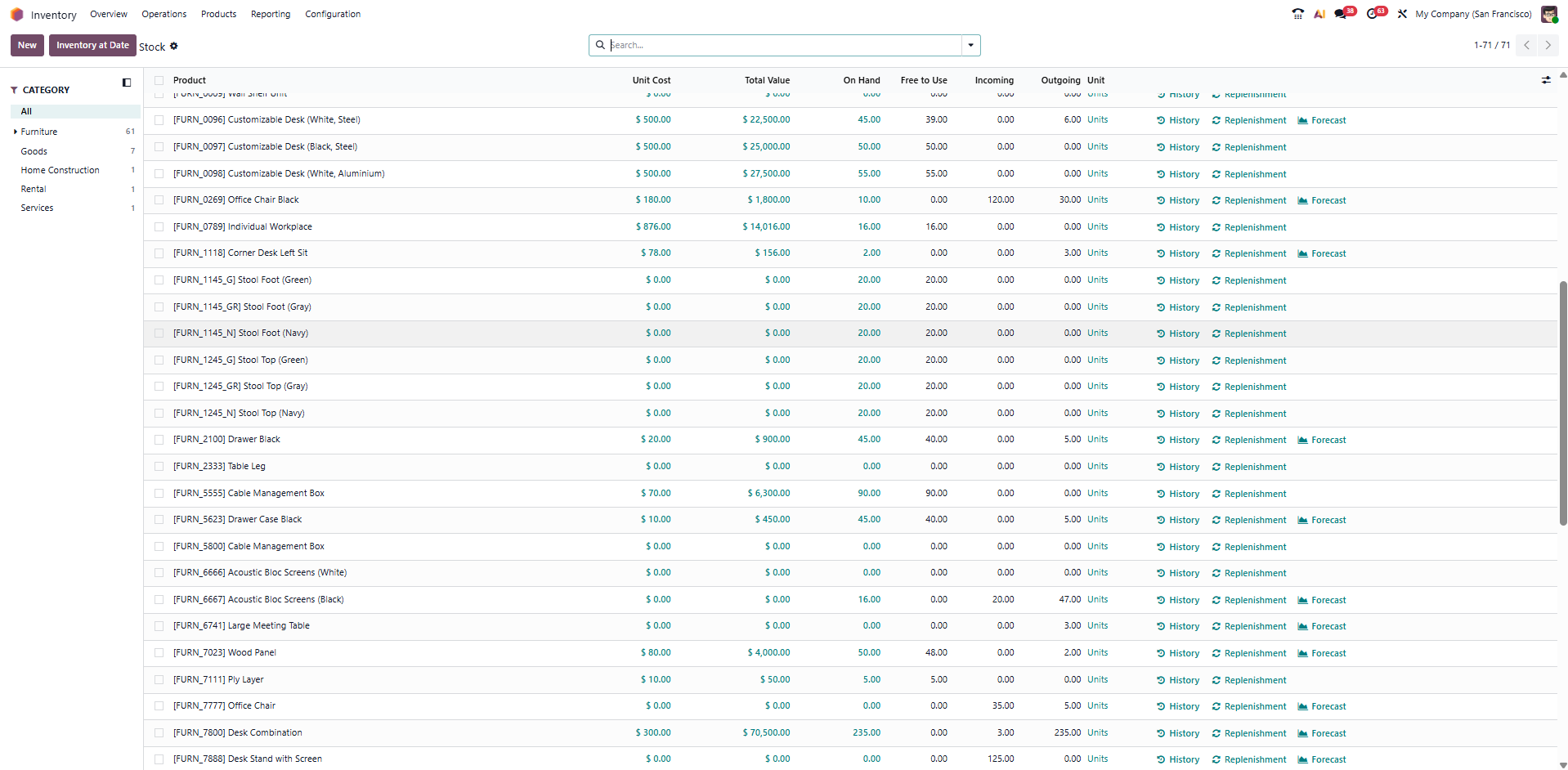
Inventory Management at Odoo
Effective inventory management is at the heart of a successful business, directly impacting profitability, operational efficiency, and customer satisfaction. With the Odoo inventory app, companies gain a powerful tool to track and control the flow of goods from purchase to sale. The app enables businesses to monitor stock movements, manage expiration dates, and ensure accurate inventory valuation at every stage. By leveraging real-time data, businesses can optimize stock levels, streamline replenishment processes, and make informed decisions that reduce storage costs and prevent stockouts. For example, tracking unit costs and monitoring the movement of goods helps companies maintain up-to-date information on their inventory, ensuring that every purchase and sale is reflected accurately. With Odoo, inventory management becomes a strategic asset, helping businesses improve their bottom line and deliver better service to their customers.
What Is a Stock Sheet?
A stock sheet (sometimes called a stock card) records the full history of a product’s inventory movements. It includes incoming goods, outgoing deliveries, internal transfers, adjustments, and replenishments.
Each line in a stock sheet reflects a specific moment in time and shows how quantity, location, and value change after each operation. In Odoo, this information is updated in real time and remains accessible for historical analysis.
A typical stock sheet includes:
- Date of movement
- Movement type (receipt, delivery, internal transfer, adjustment)
- Quantity in and out
- Initial and final stock
- Location
- Additional information such as serial number, lot, or expiration date
Each column in the stock sheet represents a field in Odoo. Users can customize or add fields such as date, reference, product, quantity, and remaining quantity to tailor the stock sheet for more detailed analysis.
Why Stock Sheets Are Important
Stock sheets are critical for both operational control and strategic decision-making.
1. Monitoring stock movements
Every stock movement is recorded and traceable. This improves transparency and allows teams to understand exactly how inventory changes over time.
2. Replenishment planning
By reviewing stock history and current quantity, businesses can define smarter replenishment rules and avoid stock-outs or overstock situations.
3. Inventory valuation accuracy
Stock sheets support accurate inventory valuation by reflecting unit cost changes, purchase prices, and valuation methods such as FIFO or average cost.
4. Loss and anomaly prevention
Unexpected stock differences can be detected early. This helps prevent losses, misplacements, or unrecorded movements.
5. Performance optimization
Managers can analyze stock data to improve warehouse processes, picking flows, and purchasing strategies.
Explore Smarter Inventory Contro with Odoo
Turn real-time stock data into clearer daily inventory decisions
Setting up the Inventory App
Getting started with the inventory app in Odoo is a straightforward process that sets the foundation for efficient inventory management. Users begin by creating a new inventory record, where they define key settings such as inventory location, unit of measure, and the preferred valuation method. The app’s import stock feature allows businesses to quickly bring in existing stock data from Excel or CSV files, making it easy to migrate from other systems or set up opening balances.
Integration with other Odoo modules, like the manufacturing app and purchase module, ensures that every purchase order or manufacturing operation automatically updates stock levels in real time. For example, when a purchase is made, the inventory app instantly reflects the new quantity on hand, providing users with accurate and timely information. By configuring these settings and utilizing the import tools, businesses can streamline their inventory processes and ensure that their data is always up to date.
Creating a Stock Sheet in Odoo Inventory App
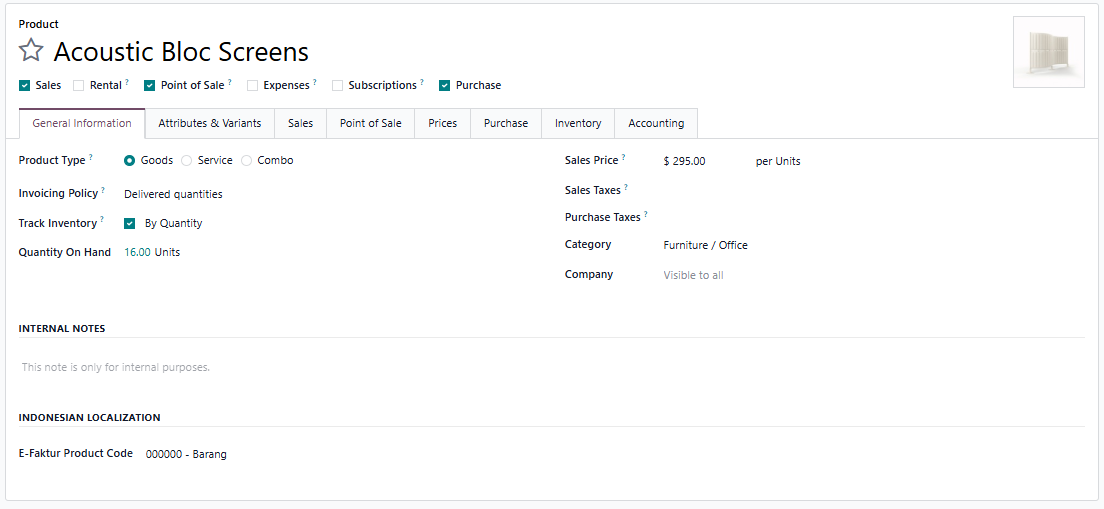
Stock Sheet in Odoo Inventory App
The inventory app in Odoo provides all the tools needed to create and manage stock sheets without manual spreadsheets.
- Go to the Inventory module and select the 'Inventory Adjustments' menu.
- Click 'Create' to start a new stock sheet.
- Alternatively, you can import stock inventory adjustments from CSV or Excel files. During the import process, you must specify fields such as external ID, location, and quantity in the import file. This allows you to efficiently add large volumes of stock data to your inventory.
- Enter the product details, quantities, and locations as required.
- Once saved, any newly added stock information is automatically reflected in the stock sheet and valuation reports, providing an up-to-date overview for accounting and stock tracking.
Steps to create and access a stock sheet
- Access the Inventory App
Log in to Odoo and open the Inventory application. - Select the product
Search and select the product you want to analyze. Odoo allows filtering by product, category, location, or company. - Open stock movements
Access the product’s movement history to see all incoming and outgoing transactions. - Review quantities and locations
The system reflects real-time stock levels per location, warehouse, or business unit. - Save and analyze data
All data is automatically saved and linked to sales, purchase orders, and manufacturing operations.
Example of a Stock Sheet in Odoo
Date | Movement | Quantity | Stock Initial | Stock Final | Details |
01/01/2023 | Incoming | 100 | 0 | 100 | Supplier reception |
05/01/2023 | Outgoing | 20 | 100 | 80 | Sales delivery |
10/01/2023 | Incoming | 50 | 80 | 130 | Replenishment |
15/01/2023 | Outgoing | 30 | 130 | 100 | Customer order |
This example reflects how each movement updates stock quantity and keeps a complete history.
Real-Time Inventory Control
One of the strongest advantages of Odoo is real-time visibility.
As soon as a purchase order is received, a sales delivery is validated, or a manufacturing order is completed, the stock sheet updates instantly. Teams no longer need to wait for end-of-day reports or manual updates.
This real-time control helps:
- Improve decision-making
- Align sales and inventory
- Prevent operational delays
- Keep data consistent across departments
Import Stock and Historical Data
Odoo allows businesses to import stock and historical inventory data when starting or migrating from another system.
Using import tools, companies can upload:
- Opening stock quantities
- Unit costs and inventory value
- Serial numbers and lots
- Expiration dates
- Stock locations
This ensures continuity and accurate inventory valuation from day one.
Set Up Odoo Inventory the Right Way
Get expert guidance to set up Odoo Inventory correctly from the start
Inventory Valuation and Accounting Integration
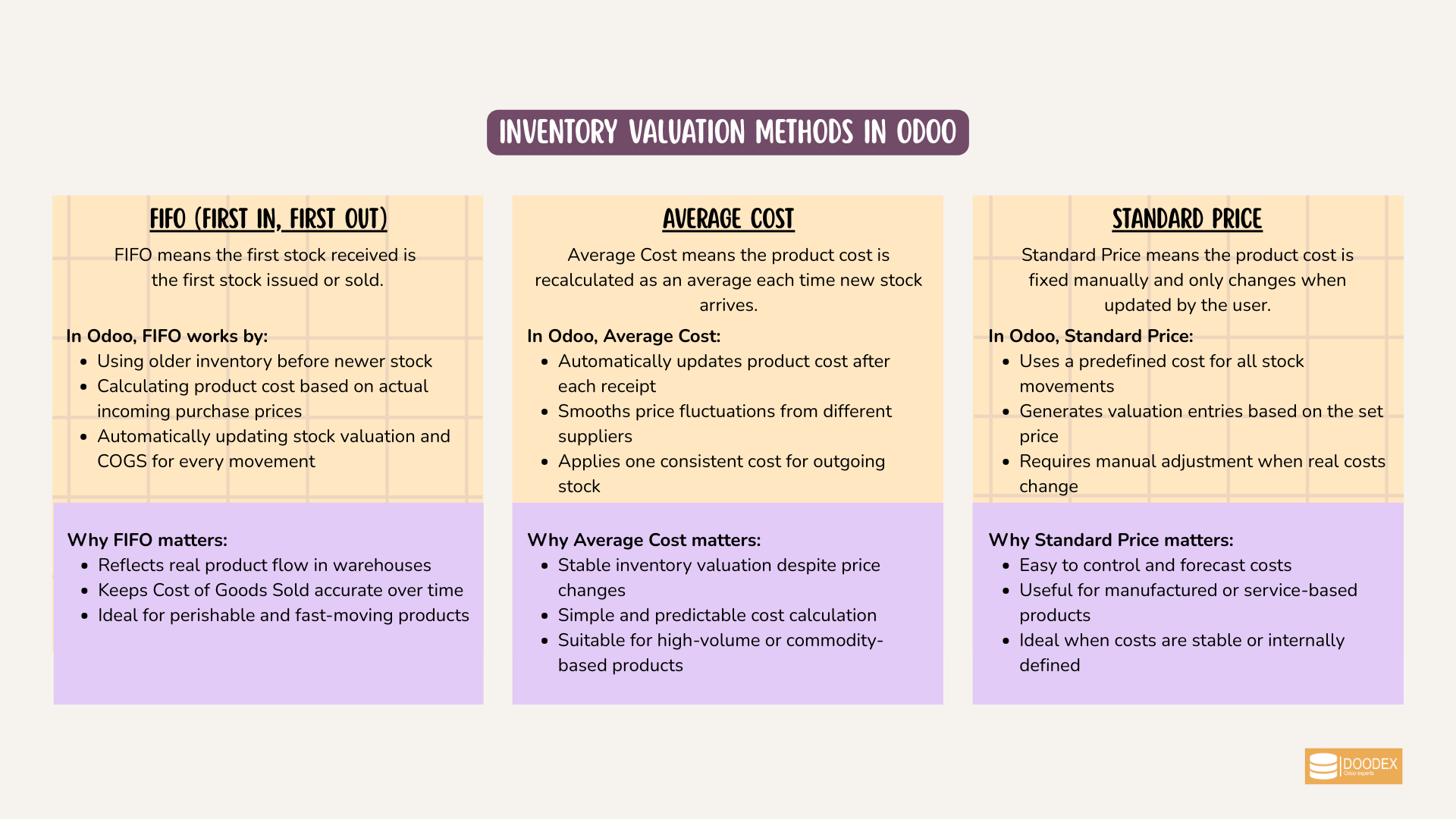
Odoo inventory costing methods FIFO, Average Cost, and Standard Price
Stock sheets in Odoo are tightly connected to accounting. Each stock movement can generate valuation entries based on the selected costing method.
Supported valuation approaches include:
- FIFO
- Average cost
- Standard price
This integration ensures that inventory value always reflects reality and aligns with financial reports.
Advanced Features: Lots, Serial Numbers, and Expiration Dates
For businesses dealing with regulated or perishable goods, Odoo supports:
- Lot and serial number tracking
- Expiration dates
- Traceability from supplier to customer
All this information appears directly in the stock sheet, improving compliance and audit readiness.
Personalization and Customization
Odoo’s inventory app is designed with flexibility in mind, allowing businesses to personalize and customize the system to fit their unique requirements. Users can easily add custom fields to track specific information such as expiration dates, serial numbers, or lot numbers, ensuring that every detail relevant to their products is captured. The app also enables the creation of personalized reports, giving users the ability to analyze stock movements and inventory data in ways that best support their business goals.
Real-time visibility into stock movements means that users can respond quickly to changes in demand or supply, while customizable notifications and alerts help teams stay proactive such as receiving a warning when stock levels fall below a set threshold. With these options, businesses can create a tailored inventory management experience that delivers the right information at the right time, helping them stay ahead in a competitive market.
✨Pro Tip
Start simple, trust the stock sheet
Configure basic stock movements first, validate quantities and unit cost, then add automation (reordering rules, valuation, lots).
Clean data → reliable inventory → better decisions
PDF Stock Sheet and Reporting Options
Odoo allows users to export stock sheets as PDF reports for documentation, audits, or sharing with external stakeholders.
Steps to generate a stock sheet PDF
- Open the product or stock movement view
- Select the relevant date range or movements
- Choose the print or export option
- Customize layout and content
- Download and save the PDF
Reports can be adapted to include additional fields, totals, or valuation details.
Integration with Other Odoo Apps
Stock sheets do not work in isolation. They integrate seamlessly with other Odoo apps:
- Purchase app: Incoming goods update stock automatically
- Sales app: Deliveries reduce stock in real time
- Manufacturing app: Consumption and production update inventory
- Accounting app: Valuation entries reflect stock movements
This unified process eliminates data silos and manual reconciliation.
Best Practices for Stock Management
To get the most out of Odoo’s inventory app, businesses should adopt proven best practices for stock management. Regularly updating inventory quantities and tracking unit costs ensures that data remains accurate and reliable. Monitoring stock movements in real time helps teams quickly identify discrepancies and respond to changes in demand. Implementing inventory valuation methods like FIFO or LIFO supports precise accounting and financial reporting, while automated tracking and real-time reporting features in the inventory app make these processes seamless.
Customizable alerts and notifications keep users informed about critical stock levels, enabling timely replenishment and reducing the risk of stockouts or overstocking. For ongoing team development, companies can create and share instructional videos on YouTube, providing step-by-step guidance on using the inventory app and its features. By following these best practices and leveraging Odoo’s robust tools, businesses can improve inventory accuracy, reduce costs, and enhance overall customer satisfaction.
Need Accurate Inventory & Financial Alignment?
Discuss your inventory and accounting needs with our Odoo specialist
Conclusion
A stock sheet on Odoo is far more than a simple inventory record. It is a real-time reflection of how goods move, gain value, and support daily business operations. By centralizing stock movements, quantities, locations, unit costs, and historical data in one system, Odoo turns inventory into a reliable decision-making asset rather than a source of uncertainty.
With tight integration across inventory, sales, purchases, manufacturing, and accounting, stock sheets ensure that every transaction is consistent, traceable, and accurately valued. Features such as real-time updates, inventory valuation, serial and lot tracking, expiration dates, and PDF reporting allow teams to work with confidence and clarity at every moment.
For growing businesses and established organizations alike, using stock sheets in Odoo helps optimize replenishment, reduce losses, improve operational efficiency, and maintain full control over inventory data. In short, Odoo stock sheets provide the structure and visibility needed to manage inventory effectively, scale operations smoothly, and support long-term business performance.
FAQs
A stock sheet in Odoo records all inventory movements for a product, including incoming, outgoing, and internal transfers, in real time.
Yes. Odoo supports serial numbers, lots, and expiration dates directly within stock sheets.
Inventory valuation is automatically calculated based on the selected costing method and linked to accounting entries.
Yes. Odoo allows importing stock quantities, unit costs, locations, and additional information using import tools.
Yes. Stock levels update instantly after each validated operation.
Yes. Odoo provides PDF export options for stock sheets and inventory reports.
Access depends on user roles and settings, allowing companies to control who can view or modify inventory information.