
Odoo Manufacturing configuration: a step-by-step guide

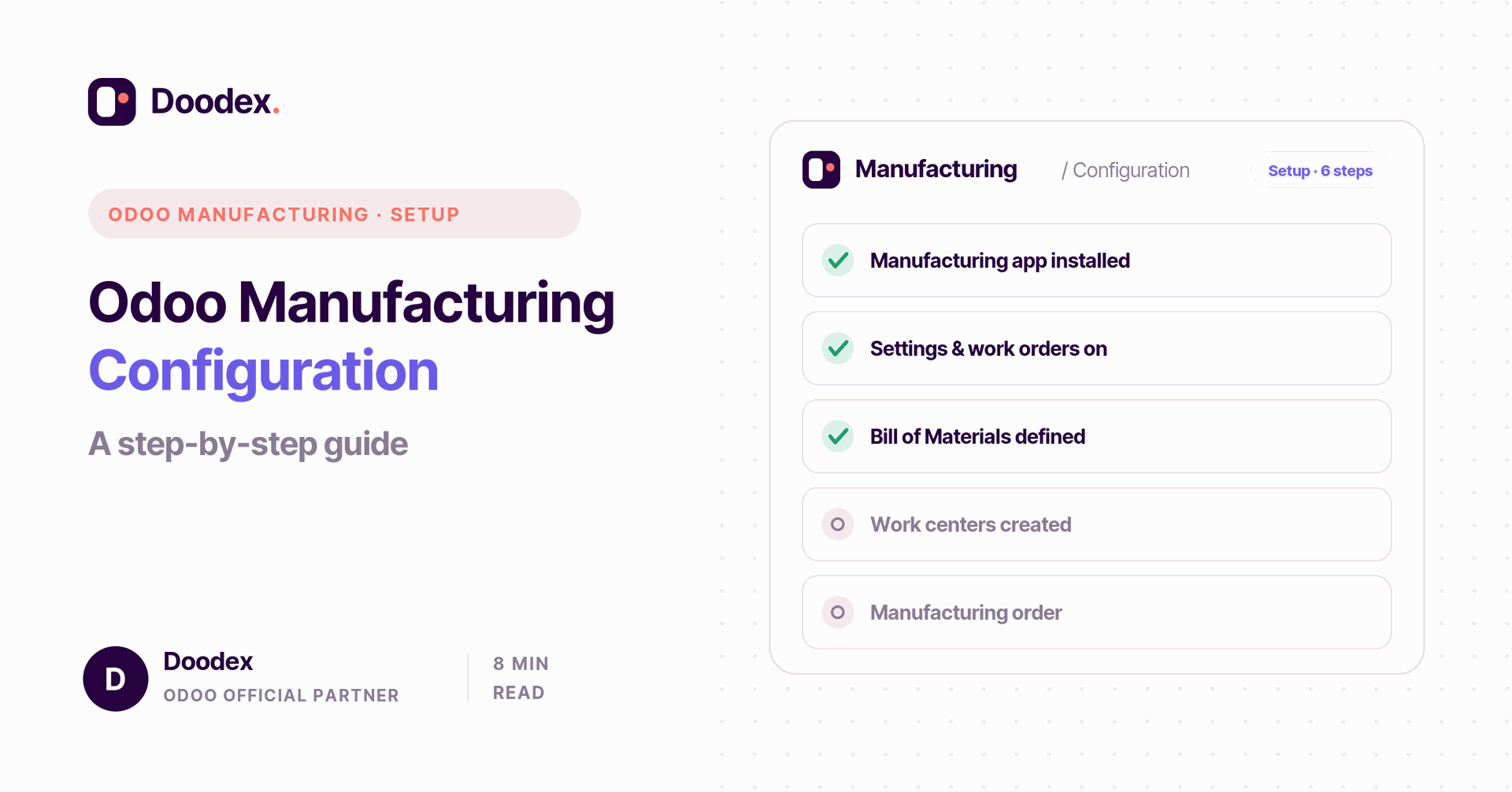
This step-by-step guide shows you how to set up Odoo Manufacturing configuration from scratch. The Odoo Manufacturing module — the core modern MRP software component in the Odoo suite — turns raw materials into finished products by linking a bill of materials, work orders, and each work center into one clear manufacturing process. Whether you run simple or three-step manufacturing, Odoo creates the right documents automatically and gives you real control over production management and cost.
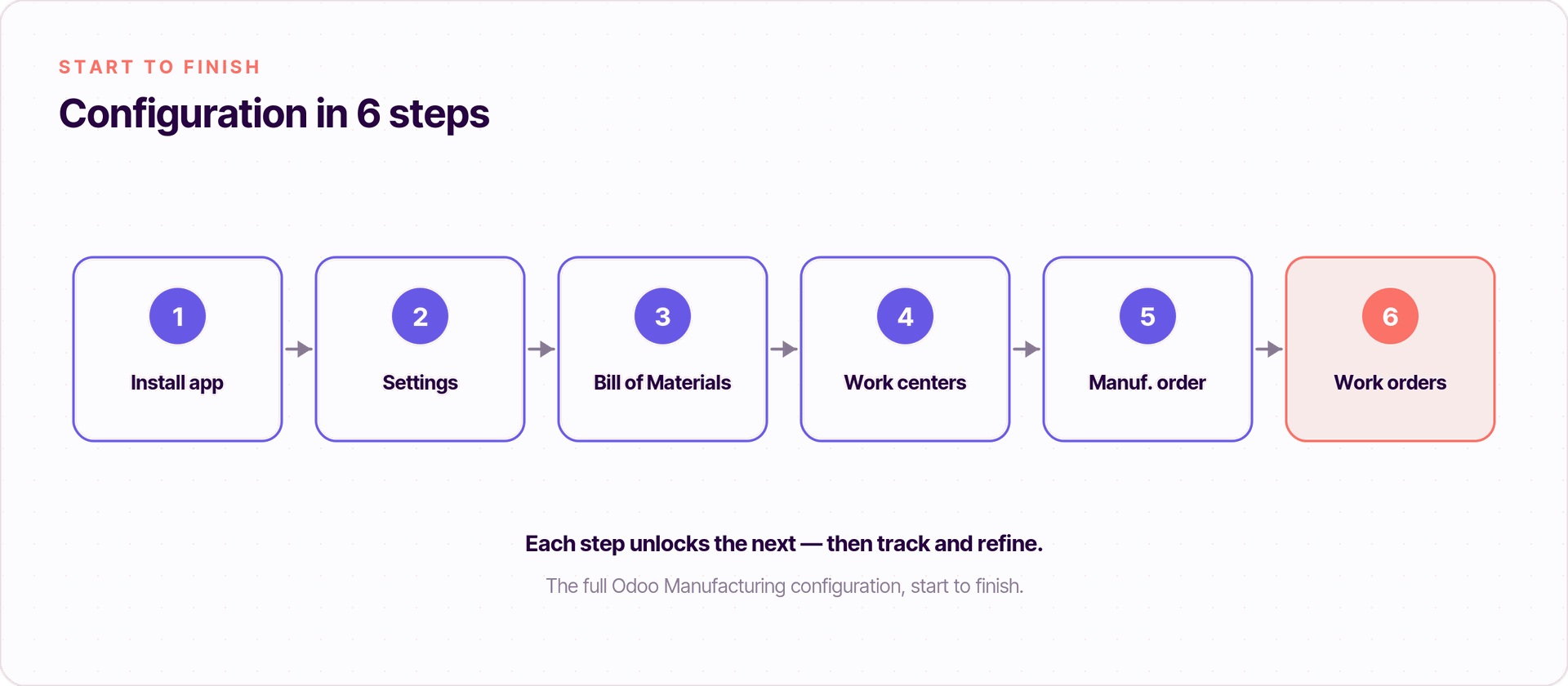
In this guide you will install the manufacturing app, configure the basic settings, define your bill of materials (BoM), set up operations, create a manufacturing order, and track work orders on the shop floor.
session
Book a free manufacturing setup session
See how Odoo Manufacturing maps to your BoMs, work centers, and shop floor — in a free session with a Doodex specialist.
Book a free sessioncontents
- 01What the Odoo Manufacturing module does
- 02Installing the Manufacturing app
- 03Configure the basic manufacturing process
- 04Define your Bill of Materials (BoM)
- 05Bill of materials types and structures
- 06Operations and the work center
- 07Create a manufacturing order
- 08One, two, or three step manufacturing
- 09Managing work orders on the shop floor
- 10Tracking finished products and serial numbers
- →Conclusion
What the Odoo Manufacturing module does
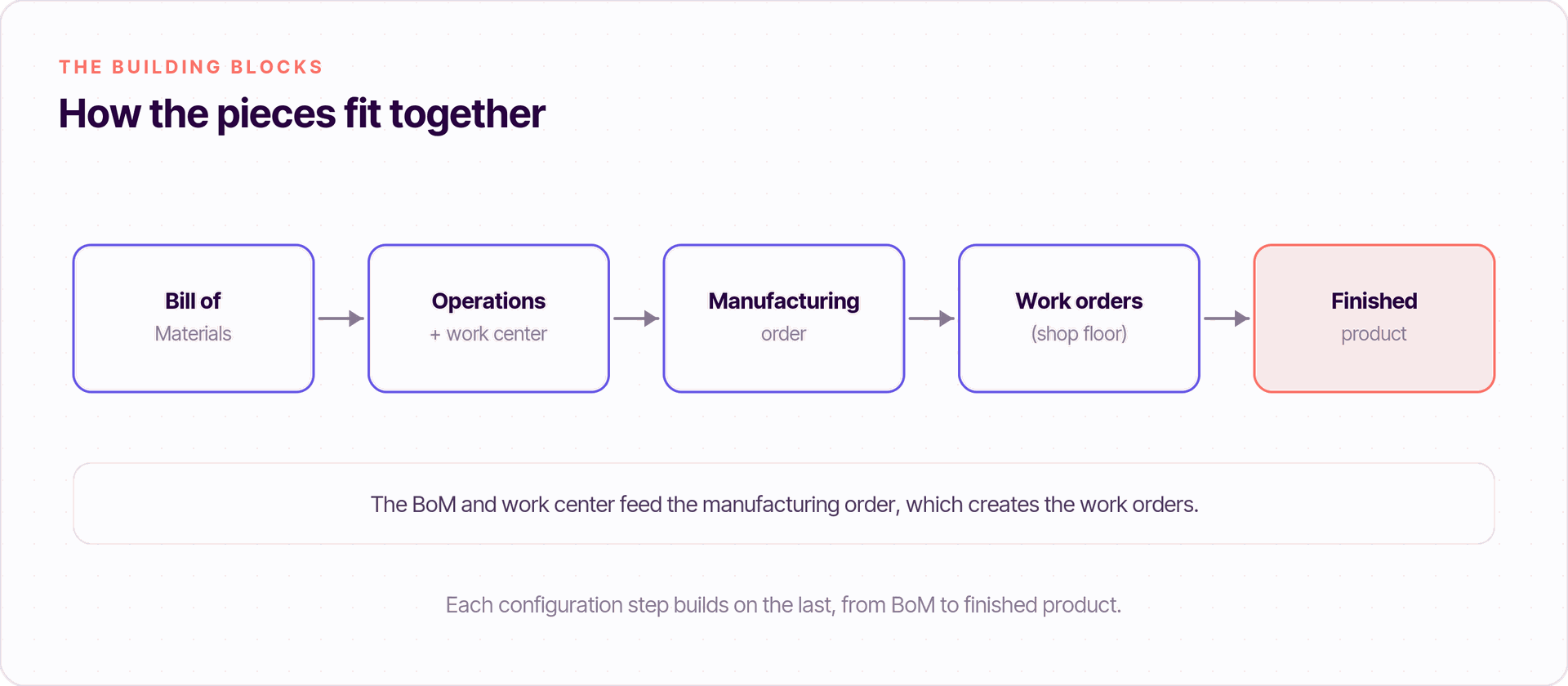
The manufacturing module is the part of Odoo Manufacturing that plans and runs production. Before you start the configuration, it helps to know its four building blocks:
- Bill of Materials (BoM). The list of components and materials needed to manufacture a product.
- Work orders. The instructions for each step of the production process.
- Manufacturing orders. The overall order to produce a specific product.
- Operations & work centers. The sequence of operations required and where they run.
Together these let you plan, track, and improve efficiency across your manufacturing operations in one system. To follow along, you need an Odoo instance with admin access and basic knowledge of your own manufacturing process.
Installing the Manufacturing app
First, install the app. Log in to your Odoo instance, open the Apps menu, search for "Manufacturing", and click Install. Odoo adds the manufacturing app to your environment, and you will see it on the main dashboard. If you also want operators to report progress from a tablet, install the Shop Floor module at the same time.
Configure the basic manufacturing process
Open the manufacturing module from the main dashboard, then navigate to Configuration > Settings. Here you set how detailed your manufacturing process should be:
- Work Orders. Turn this on so each step is enabled as a separate task.
- BoM types. Pick the structures you need — Manufacture, Kit, or Subcontracting.
- Operations. Enable operations if your production process needs a set sequence.
These settings shape everything later, so match them to how your company really works. You can change them anytime as you streamline operations.
Define your Bill of Materials (BoM)
Now create your first BoM. Navigate to Products > Bill of Materials and open a new BoM. Choose the specific product you want to manufacture, then on the components tab click Add a line for each raw material and set the quantity. On the operations tab, add the steps if your build has them.
This is where you list exactly what goes into your finished goods. Getting the components and quantities right here keeps your inventory counts accurate and supports tight cost control later.
Bill of materials types and structures
The bill of materials can do more than list parts. Use a Kit BoM to sell a bundle, a Subcontracting BoM when a partner builds it, and a multi-level BoM when a product contains sub-assemblies that each have their own BoM. You can also handle by-products — extra outputs created alongside the main item — and capture extra notes on the general information tab.
Free session
Want your Manufacturing setup done right?
Book a free working session with a Doodex Odoo specialist and configure BoMs, work centers, and orders around your real production.
Book a meetingOperations and the work center
A work center is where an operation happens — a machine, a bench, or a team. Go to Configuration > Work Centers and create each one, setting its capacity, cost per hour, and time efficiency. Then, on each BoM operation, assign the right work center.
You can also set an alternative work center so a job can run elsewhere if the first is busy — a simple way to avoid bottlenecks and improve efficiency. Each operation defines the operations required, the duration, and the instructions operators see.
Create a manufacturing order
With the BoM and work centers ready, you can raise a manufacturing order. Go to Operations > Manufacturing Orders and click Add to start a new one. Select the product and confirm the correct BoM, set the quantity, then schedule a start date and assign the responsible users.
When you confirm the order, Odoo creates the matching work orders automatically — no manual copying. A pop-up window may ask you to reserve materials if stock is short, so you always know your inventory position before you produce.
One, two, or three step manufacturing
Odoo lets you choose how goods flow through your warehouse. In the Inventory tab of the warehouse settings, pick one-step (manufacture in place), two-step (pick components, then manufacture), or three-step manufacturing (pick, manufacture, then store). More steps give finer tracking; fewer steps keep things fast. Choose the option that fits your manufacturing operations.
Managing work orders on the shop floor
Once an order is confirmed, the team works through its work orders on the shop floor. Operators see each stage, follow the instructions, record time, and update progress. As each step finishes, they complete work orders and move to the next, so managers can track live status and keep productivity high.
The optional Shop Floor view turns this into a clean, tablet-friendly screen — handy for capturing real details from the line without paperwork.
Tracking finished products and serial numbers
When production ends, Odoo records the finished products back into inventory. If a product is tracked, you assign lots or serial numbers at this point, giving you full traceability from raw materials to the final item. Reports then show work center performance, BoM cost, and overall efficiency, so you can refine the configuration over time.
Conclusion
Setting up Odoo Manufacturing configuration is straightforward when you take it one step at a time: install the manufacturing app, set the basics, build your bill of materials, define each work center, then create a manufacturing order and run the work orders. The payoff is a clear production management setup that helps you streamline operations, tighten cost control, and improve efficiency across the manufacturing process.
Need help? As an official Odoo partner, Doodex can implement, customize, and support your Odoo Manufacturing setup end to end — from the first configuration to training and ongoing documentation — so your business gets the most from the manufacturing module.
Your Odoo partner
Ready to configure Odoo Manufacturing?
Doodex implements, customizes, and supports your Odoo Manufacturing setup end to end - from the first configuration to training and documentation. Talk to our team to get started.
Talk to a Doodex expertanswered
What is a Bill of Materials in Odoo?
A bill of materials lists the components and quantities needed to manufacture a product. It is the base of every manufacturing order.
Do I need work orders?
Only if you want to manage each step. Enable work orders in settings; when you confirm an order, Odoo creates them for the shop floor.
What is three-step manufacturing?
Three-step manufacturing means pick components, produce, then store the finished products — set in the warehouse Inventory tab.
How do I track each item?
Assign lots or serial numbers when the manufacturing order is done, for full traceability from raw materials to finished item.