
What SAP Extended Maintenance Costs

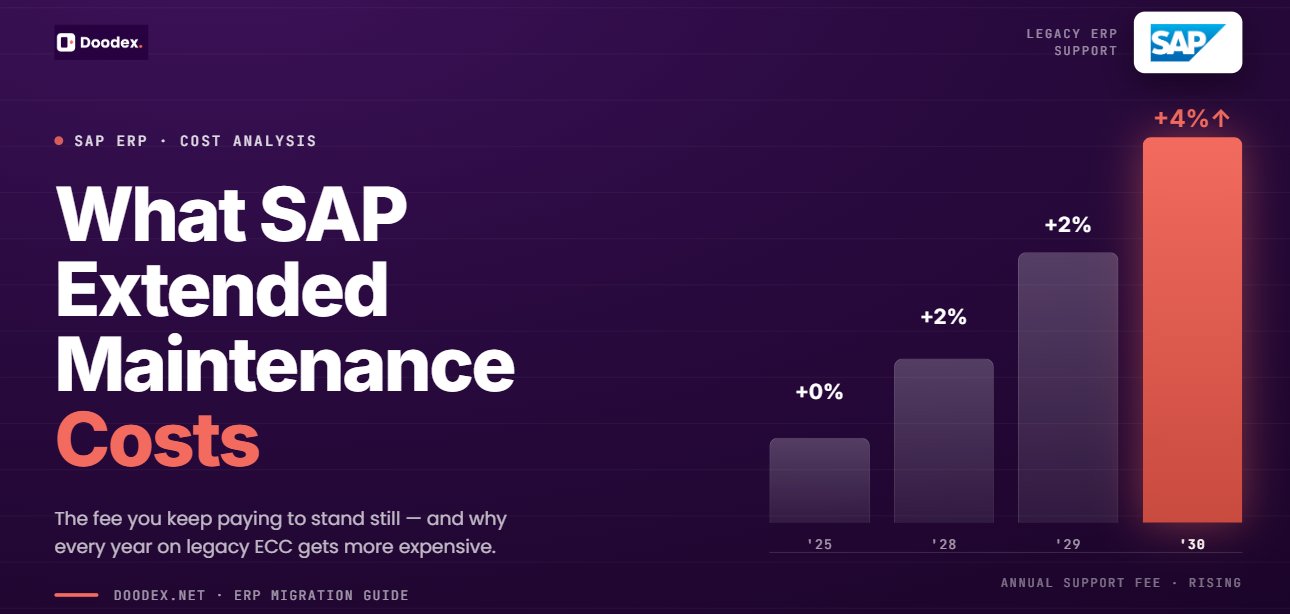
For manufacturers running SAP ECC, staying past the 31 December 2027 deadline is no longer an IT discussion — it is an expensive commercial decision. SAP's Extended Maintenance (2028–2030) triggers a strict +2-point premium on your annual net licence fees. This guide breaks down the real math behind that budget bleed, and shows how the same premium can instead fund a modern ERP transition.
takeaways
Extended maintenance is a 2028–2030 window only. It runs after mainstream maintenance ends on 31 December 2027 for SAP ECC 6.0 and SAP Business Suite 7 — and not a day beyond 2030 for most on-prem customers.
The +2-point premium is the headline cost. It lifts Enterprise Support from about 22% to ~24% of net licence value per year; Standard Support goes from 17% to ~19%.
This is seven-figure money. A $15M licence estate pays about $300k extra per year; a $50M estate pays about $1M extra per year — just to keep legacy systems running.
You buy time, not innovation. The premium covers critical security patches and legal changes, but no new functionality. ECC is effectively frozen.
The same budget can fund a phased exit. An Odoo migration with Doodex typically lands at one-third to one-quarter of a full S/4HANA or RISE programme over five years.
What “extended maintenance” actually is — 2028–2030, the +2-point premium
SAP extended maintenance is optional support for eligible SAP ECC, SAP ERP 6.0 and SAP Business Suite systems after mainstream maintenance ends. For SAP ECC 6.0 the key date is 31 December 2027.
Per SAP licensing analysis, extended maintenance for ECC typically runs from 1 January 2028 to 31 December 2030 and adds +2 percentage points to your existing maintenance rate:
| Current SAP maintenance rate | Extended maintenance rate |
|---|---|
| Standard Support — 17% | 19% |
| Enterprise Support — 22% | 24% |
It is charged on the same net licence value as your base maintenance, requires a separate agreement or addendum, and the additional fee becomes material quickly. Scope can include SAP ERP, CRM, SCM and Business Suite on HANA depending on your landscape and eligibility — confirm the exact options with your SAP account team in writing.
SAP has also introduced a separate SAP ERP private-edition transition option inside RISE with SAP. This can extend support to 2033 only for selected customers in qualifying cloud contracts — it does not extend classic on-premise mainstream maintenance.
What happens after 2030 if you stay on ECC
Extended maintenance is time-boxed. For most on-prem SAP ECC customers, 2030 is the practical wall.
If you do not migrate to S/4HANA, RISE, or another ERP, you move into customer-specific maintenance. Security patches are provided for 12 months, then coverage narrows: few or no new support packages, restricted SAP Notes, limited legal changes, and no guaranteed new interfaces.
In plain English: customer-specific maintenance can mean paying similar fees for less vendor support.
Need the full picture of what 2027 really means?
What the premium does — and does NOT — buy you
Extended maintenance provides critical security patches and legal updates for an additional fee: selected bug fixes, critical SAP Notes and statutory updates where covered. That can be valuable if you need payroll, VAT, statutory reporting or trade-compliance stability while you migrate.
But it provides no new functionality. Expect no new enhancement packages, no new interfaces, no innovation from SAP product engineering. ECC is effectively frozen — the release is in late life.
This is why extended maintenance is designed as a bridge to a modern solution, not a future operating model. There is also opportunity cost: money spent on 2028–2030 maintenance cannot also fund process redesign, custom-code cleanup, or an upgrade project.
Limits around compliance, security, and new interfaces
Do not assume every local tax, e-invoicing, logistics or industry-cloud change will be back-ported to ECC. Manufacturers with multi-country plants should map the legal changes, partner portals, security standards and integrations that are business-critical. The risk is not only the SAP invoice — it is the hidden consulting needed to keep old systems secure, compliant and connected.
No sales script
Get your free SAP ECC migration audit
Turn the 2027 deadline into a plan. Doodex reviews your SAP licence footprint, custom code, integrations and risk after 2027 — with indicative migration costs and realistic options across extended maintenance, S/4HANA / RISE, and SAP ECC → Odoo.
SAP Diagnostic Diagnostic SAPThe real cost — a worked example for a mid-size manufacturer
Use this CFO formula: extended-maintenance premium per year = net licence value × 2%.
Example: a manufacturer with $15M of SAP ECC licence value paying Enterprise Support at 22%.
| Estate | Premium impact |
|---|---|
| $15M licence value | $3.3M → $3.6M / yr+$300k per year · ~$900k over 2028–2030 |
| $50M licence value | $11M → $12M / yr+$1M per year just to keep legacy running |
At a 17% Standard Support baseline, the move to 19% is an 11–12% uplift. Account-team quotes can start higher still: independent reviews reveal 30–50% overpricing in extended-maintenance quotes, and pricing is negotiable. Treat the first offer as a starting point, not a final number.
Spend $0.9M–$3M to keep a frozen system alive — or redirect the same budget into a system that still grows.
Tip · Model five years, not oneWhat the same money could fund instead
If the extra extended-maintenance cost is $300k–$1M per year, that is $0.9M–$3M over three years — for many mid-size manufacturers, enough to fund a serious transition.
The official path is S/4HANA or RISE with SAP. That may suit some customers, but total cost runs high once infrastructure, cloud subscription, change management and integrators are included. Odoo is a modern ERP covering manufacturing, finance, inventory, quality, maintenance and services.
Doodex migrates manufacturers from SAP ECC to Odoo in phases — plant by plant, business unit by business unit — keeping ECC as a safety net until the new system is stable. Typical Odoo + Doodex programmes land at one-third to one-quarter of an equivalent S/4HANA or RISE programme over five years.
A simple decision frame for 2027–2030
Put three options in front of the executive board:
The right answer depends on your licence base, end date, custom code and appetite for change. But “do nothing and keep paying SAP” is rarely the cheapest route once you model five years of cost, risk and duplicated project spend.
Wondering if you've already left it too late?
answered
Is SAP extended maintenance mandatory once mainstream maintenance ends?
No. Extended maintenance is optional. If you do nothing, the system usually moves into customer-specific maintenance after the mainstream end date, with a reduced support scope.
Does extended maintenance cover every legal and tax change?
No guarantee. It usually covers critical legal changes, but coverage varies by country, product and component. Ask SAP for written confirmation by jurisdiction.
Can I sign extended maintenance and still migrate to Odoo before 2030?
Yes. It is a commercial support bridge, not a technical lock-in. Check notice periods so you don't pay SAP maintenance longer than needed.
Is third-party support a viable alternative?
It can cut ongoing maintenance cost, but involves trade-offs around direct SAP support, upgrade paths and access to official SAP Notes. Evaluate the full operational risk to your factory floor, not just the upfront fee reduction.