MRP software is the tool that plans production for manufacturers. It tracks raw materials, calculates what you need, schedules production, and keeps inventory levels in check — all from one system.
Discover what MRP software can gain you
4 minutes to quantify what Odoo can bring to your production.
ODOO MRP · LIVE GANTT · 47 orders across 4 production lines
Line A
Line B
Line C
Line D
Line E
PlannedIn progressDoneQueued
Auto orders · Real-time · On-time
The result: you meet customer demand without overbuying or running short. For small manufacturers, growing businesses, and larger operations alike, MRP software helps reduce costs, improve scheduling, hold the right inventory levels, and deliver customer orders on time.Every finished product you ship depends on the same question: what raw materials do you need, when do you need them, and how much? Material Requirements Planning — MRP — is how modern manufacturers answer that question every day, for every product, in real time.Below, you'll see how MRP works, where it fits in your manufacturing process, how it handles inventory and capacity planning, what to consider during implementation, how MRP and ERP systems compare, and why Odoo is the all in one solution built for the next generation of manufacturers.
See Doodex in action
How Doodex turns Odoo into a real MRP
Native Odoo covers the basics. Doodex adds the advanced MRP layer — live scheduling, capacity planning, and shop-floor visibility manufacturers actually need.
What is MRP software?
MRP software is a control system that turns customer orders into a production plan. It works out what raw materials you need, when you need them, and how much to make. Then it generates purchase orders, work orders, and production schedules — automatically.
The MRP process combines three data inputs:
Customer demand
— sales forecasts and confirmed customer orders.
Current inventory levels
— what you have in your warehouses right now.
BOM data
— the bill of materials for every finished product.
From those inputs, MRP software calculates material requirements, creates purchase orders for missing components, and schedules manufacturing orders on your production lines.
From spreadsheets to real-time MRP systems
For years, manufacturers ran production planning on spreadsheets. That worked when things were simple. But one wrong cell, one outdated stock count, or one missed supplier email was enough to break the whole plan. The MRP meaning grew out of exactly that problem: manufacturers in the 1960s needed a control system that could hold every material requirement, every current inventory level, and every customer order in one calculation — and react before the shop floor felt the impact.
Since then, MRP systems have moved from big mainframes to today's cloud-based manufacturing software. Modern platforms give planners real-time visibility, automate procurement, and go well beyond simple material planning. They cover capacity planning, labor requirements, master production schedule generation, and just in time replenishment. What started as material planning is now a complete manufacturing resource planning software stack — sitting inside broader enterprise resource planning platforms — and the payoff shows up in delivered orders and cash flow, not just inventory reports.
How MRP software works day-to-day
Your shop floor manager opens the MRP system at the start of the day and sees the manufacturing orders to launch, in priority order, helping keep the production process moving across the shop floor. Operators log in from tablets at each work center. Every scan updates inventory in real time. Every finished product moves the master production schedule forward.
The result is one screen, one data flow, and no more parallel spreadsheets.
MRP and ERP systems: what's the difference?
MRP and ERP systems are often confused. Here is the short version.
MRP
MRP focuses on materials and inventory management
It plans what to buy, what to make, and when. MRP is mainly for manufacturing-centric processes.
ERP
ERP integrates all business processes into a single package
ERP systems include financial and customer relationship management, HR, and supply chain — with MRP as one part of it. ERP systems cover the entire enterprise.
STAGE 1MRP
STAGE 2+ financial
STAGE 3+ HR + customer relationship
FULL+ supply chain = ERP
MRP can run as a stand-alone application or as part of ERP. Many small manufacturers start with MRP alone and grow into full ERP as business needs expand.
ERP vs MRP: cost comparison
ERP systems are generally more expensive to implement than MRP. They take longer, involve more people, and require more change. That is why MRP systems are quicker and easier to implement than more comprehensive ERP systems.
If you only need to schedule production and manage inventory, MRP software alone can do the job. If you also need finance, sales, and customer relationships in one system, you will want an ERP with strong MRP built in — which is exactly what Odoo delivers.
When to choose MRP vs ERP
Choose MRP alone if you already have accounting and CRM tools and only need production planning. Choose ERP with MRP if you want one system for everything — lower cost, better data accuracy, and less friction across the business.
Either way, MRP software is how you get real-time inventory data, accurate purchase orders, and reliable production schedules.
Manufacturing processes and MRP systems
MRP systems help manage inventory and production schedules across every manufacturing process — connecting the shop floor, warehouse, purchasing, and sales.
They connect the shop floor, warehouse, purchasing, and sales — keeping materials, purchase orders, and production activities in sync through one live data flow. Effective MRP systems provide real-time visibility into inventory levels, so your team always knows what is available, what is on order, and what is scheduled for production.
That real-time picture is the whole point of MRP. It reduces customer lead times significantly, cuts stockouts, and stops the missing-part surprises that break delivery promises.
MRP · real-time visibility
one live data flow
shop floor
scheduled
production activities
warehouse
available
inventory levels
purchasing
on order
purchase orders
sales
materials
timely ordering
MRP systems automate procurement to avoid stockouts and overstock
MRP systems automate procurement and production processes. When inventory drops below the reorder point, the system generates purchase orders automatically. When new customer orders come in, MRP recalculates the master production schedule and adjusts what needs to be built and when.
The outcome is fewer stockouts, less excess inventory, and better cash flow.
MRP improves supplier communication
MRP systems help improve communication with suppliers for timely ordering. Suggested purchase orders include the right quantity, price, and lead time. Your buyers spend less time chasing quotes and more time managing supplier relationships.
Master production schedule
The MPS is the plan that tells your shop floor what to build, in what quantity, and by when.
The master production schedule (MPS) is the plan that tells your shop floor what to build, in what quantity, and by when. MRP uses the MPS as the anchor for every calculation that follows. MRP breaks the MPS into raw materials needed and materials needed for each production phase. It then generates the purchase orders and manufacturing orders required to meet the plan.
MRP uses real-time inventory data to optimize production schedules. If a component is delayed, the MPS adjusts. If a customer order is expedited, the MPS shifts to prioritize it. The plan stays current — not a snapshot from last Monday.
MPS · LIVE GANTT
The plan stays current
Today
Shift 1
8am
9am
10am
11am
12pm
1pm
2pm
3pm
4pm
5pm
Line A
MO
PO
✓
Line B
PO
MO
MO
Line C
MO
✓
PO
NOW marker · MPS shifts to prioritize expedited orders
Scheduling production based on actual demand
Modern MRP software helps planners schedule production based on both sales forecasts and actual customer orders. It blends historical data with live signals to keep production lines running smoothly.
Advanced MRP systems analyze sales orders to predict future material needs. They anticipate demand rather than react to it — which is how MRP helps manufacturers meet customer demand more consistently.
Material requirements planning MRP: the core calculation
Material requirements planning is the core function of every MRP system. It answers three questions for every finished product.
1
What do we need?
What raw materials and components do we need for each SKU?
2
What do we have?
How much do we have on hand right now, across every warehouse?
3
When to order?
When do we need to order or produce more to meet the schedule?
MRP calculates the answer for every SKU, every day. That is the MRP material requirements planning system at work — a material resource planning system that keeps your production flowing.
Data inputs and data accuracy
MRP systems require accurate data inputs for effective operation. Accurate data input is essential to MRP effectiveness. If your BOMs are wrong, your inventory counts are off, or your lead times are outdated, MRP will give you the wrong answers.
That is why every MRP implementation starts with clean master data: bill of materials, current inventory levels, supplier lead times, and historical sales. MRP systems require accurate data inputs for effective inventory management. Data accuracy is non-negotiable.
Minimizes inventory levels and costs
MRP minimizes inventory levels and associated costs. By ordering only what you need, when you need it, MRP keeps inventory costs low and avoids tying up cash in excess inventory.
Over time, MRP also cuts implementation costs across the tech stack. One system replaces several, which lowers total software spend and reduces training overhead.
MRP II: manufacturing resource planning
Classic MRP plans your materials. MRP II adds the missing half: labor and equipment capacity.
What does MRP II add to classic MRP?
MRP II — manufacturing resource planning — extends classic MRP with capacity planning and labor requirements. It answers a bigger question: not just what materials do we need, but do we have the labor and equipment to build it on time?
How does the balance work?
A modern manufacturing resource planning system balances material availability with labor and equipment capacity. It looks at your work centers, shifts, and operator skills, then adjusts the master production schedule to match reality.
Who benefits most?
For growing businesses, that is a real advantage. As your production lines expand and your product mix gets more complex, MRP II keeps materials, capacity, and commitments in balance.
From MRP to MRP II to ERP
The move from MRP to MRP II to full ERP is a natural evolution. MRP handles materials. MRP II adds capacity. ERP wraps it all together with finance, sales, and CRM. Odoo delivers all three layers in one system — a manufacturing resource planning software stack that works for small manufacturers today and scales for growing businesses tomorrow.
Manufacturing software: features that matter
Here are the MRP features every manufacturing software should have.
Manufacturing orders and work orders
Create, launch, and track manufacturing orders in real time. Every work order is tied to a routing, a work center, and an operator. Progress updates flow into the master production schedule automatically.
Bill of materials and BOM management
A Bill of Materials (BOM) is a list of raw materials and components needed for production. Managing materials starts with clean, multi-level BOMs. Modern MRP software handles sub-assemblies, alternative parts, and phantom BOMs — no spreadsheets required.
Inventory management, inventory control and serial number tracking
Track every SKU by lot or serial number. MRP software gives you real-time inventory data, inventory control across every warehouse, bi-directional traceability, and the audit trail regulated industries need.
Purchase order automation
MRP calculates what to buy, when to buy it, and from whom. It generates purchase orders with the right quantity, price, and lead time based on supplier data and historical sales.
Capacity planning
Match labor requirements and equipment capacity to the master production schedule. Balance workload across shifts. Avoid overloading bottleneck work centers.
Reporting and data accuracy
Dashboards, KPIs, and up to date data on production, purchasing, and inventory. Because MRP software improves operational efficiency by automating manual tasks, your team spends more time on decisions and less on data entry.
Inventory management with MRP software
Good inventory management is inseparable from MRP. When production is planned around real inventory data, you can:
Maintain optimal inventory levels
on every SKU
Optimize inventory levels
across warehouses
Reduce excess inventory
through better demand planning
Manage inventory
without spreadsheets or manual counts
MRP software uses historical data for demand forecasting. It compares historical sales with actual demand to keep inventory levels tight — not too high, not too low.
The outcome is lower inventory costs, fewer stockouts, and a supply chain that flows.
Just in time replenishment
MRP enables just in time replenishment. Raw materials arrive when you need them — not weeks early, not days late. Components move through production in sync with the master production schedule. Finished goods ship on the promised date.
Just in time only works with reliable MRP calculations. Without one system driving the data, JIT falls apart at the first stockout.
Meet demand with reliable production
MRP helps you meet demand — aligning production with customer orders, historical sales, and sales forecasts, so every finished product ships on its promised date.
That reliability builds customer relationships. Late shipments break trust. On-time delivery earns repeat business. MRP is how you protect customer satisfaction at scale.
Manufacturers using modern MRP consistently report:
-10 %
Manufacturing costs
at least, within 6 months
+10-20 %
Productivity
better production tracking
-20-30 %
Inventory levels
via better demand planning
-20-30 %
Stockouts
accurate raw materials anticipation
On-time
Delivery
improved on every production line
Increased
Efficiency
across the entire manufacturing process
MRP software is how manufacturers reduce costs and get the right materials to the right work center at the right time.
Beyond standard MRP: the Doodex production planning suite
MO Parent MO · schedules 47 child MOs automatically
↓
Draft 47
MO-001
MO-002
MO-003
MO-004
…and 43 more
Planned
MO-001
MO-002
MO-003
In progress
MO-001
MO-002
Done
✓ MO-001
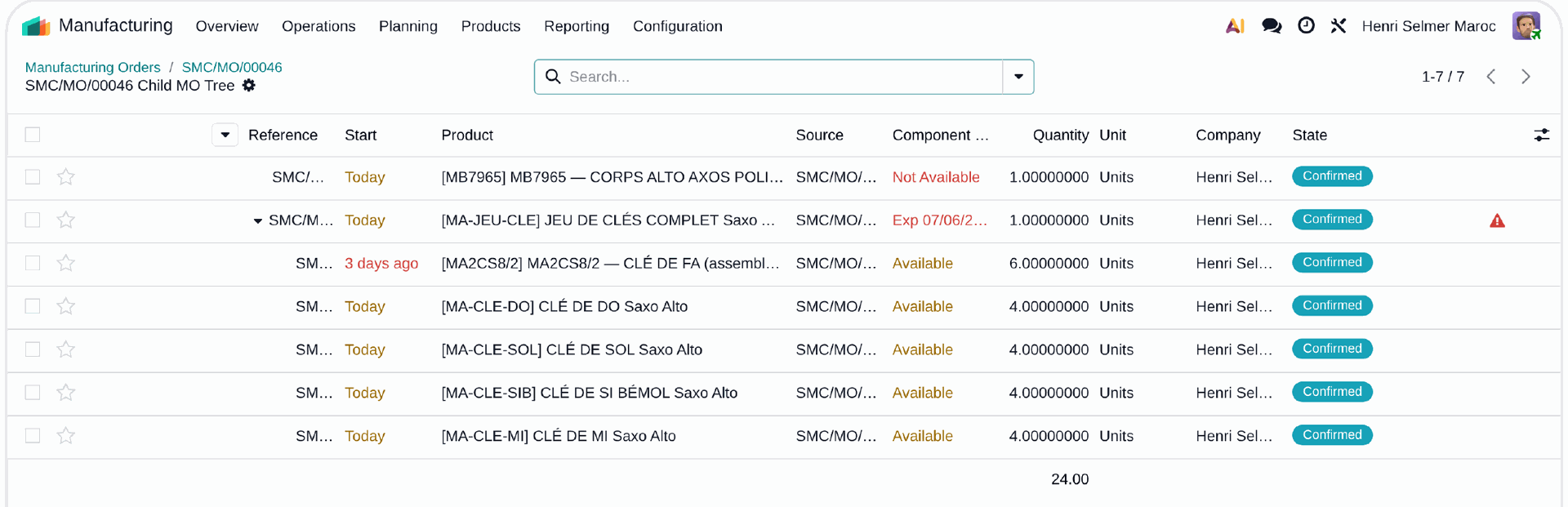
One click on the parent MO: 47 child MOs move to Planned in the right dependency order.
1. Recursive manufacturing order planning
By default, Odoo schedules manufacturing orders one at a time. On a multi-level BOM — a finished product built from sub-assemblies, themselves built from sub-assemblies — mass scheduling MO by MO is not workable: dozens of linked orders to sequence by hand. The Doodex module schedules the entire tree at once: you schedule the parent MO, all child MOs schedule themselves automatically, in the right dependency order and within the capacity of your work centers.
2. A dynamic scheduling board — also recursive
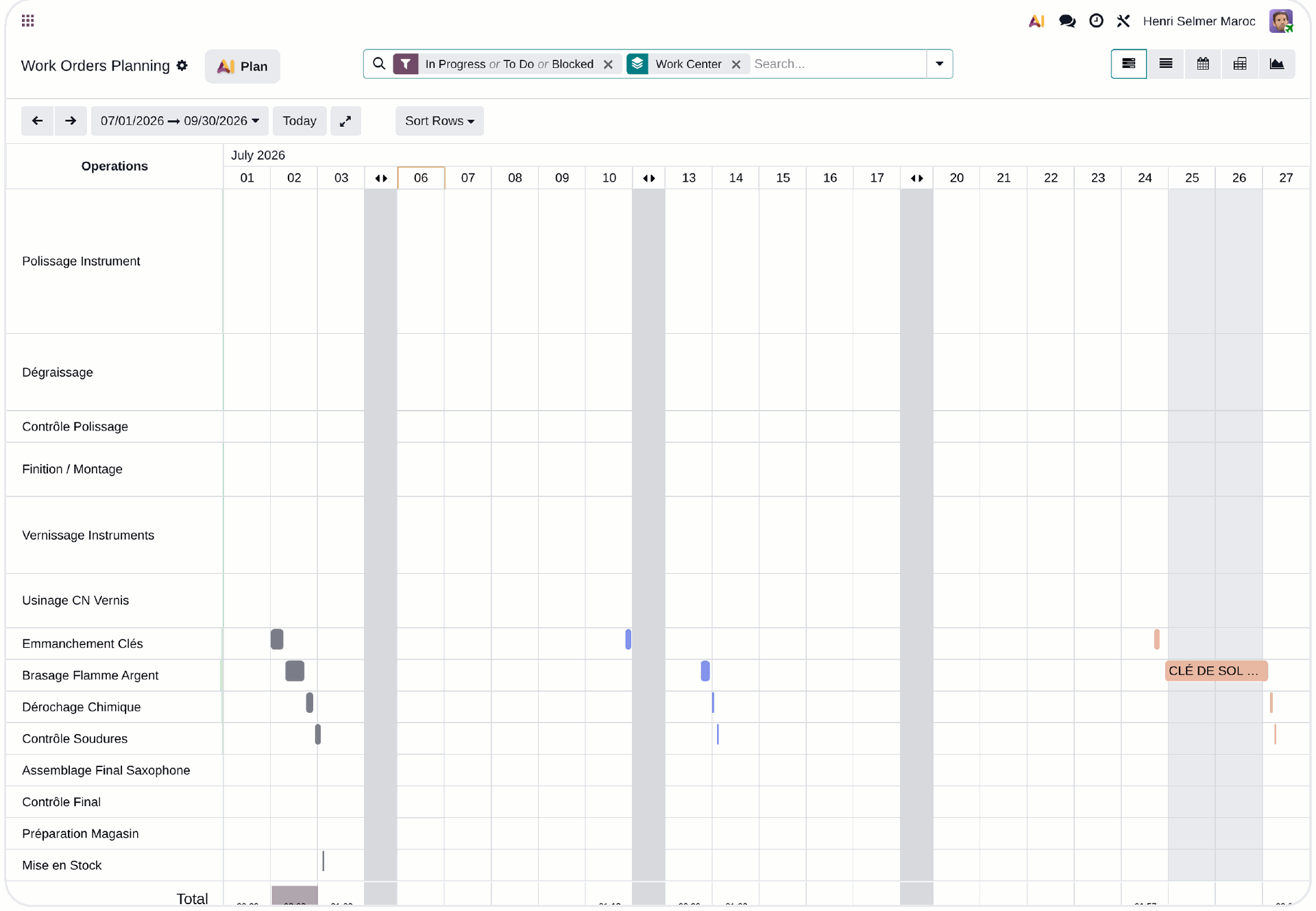
We rebuilt the scheduling interface for genuinely usable daily operations. And above all: drag a manufacturing order on the board, and the entire chain of linked MOs shifts automatically. Machine breakdown? Drop the MO, the chain follows, lead times stay consistent.
3. Retroplanning: schedule backwards from the delivery date
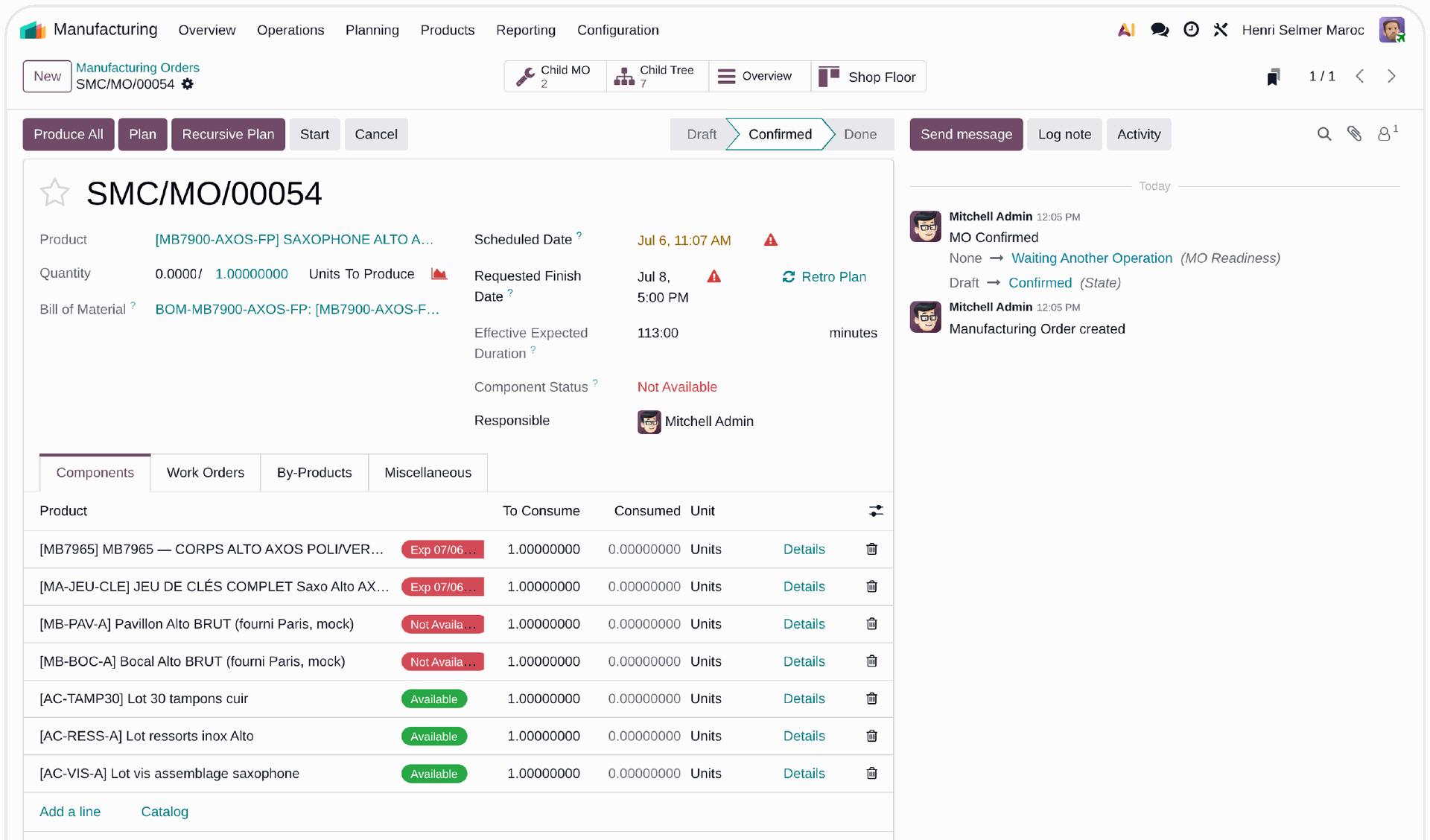
Standard Odoo schedules earliest-first, from the production start date. Manufacturing reality works the other way around: you start from the customer delivery date and want to know when to launch production. The Doodex retroplanning module computes that latest launch date across the full MO chain. Your delivery commitments finally rest on the schedule — not on guesswork.
4. Planning simulation: test before you commit ⭐
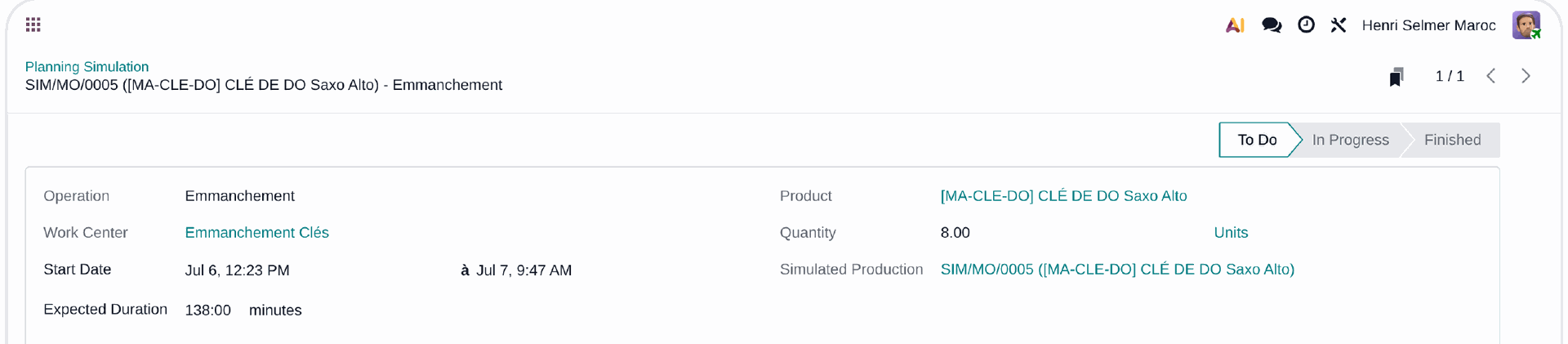
This is the game-changer — and it multiplies the impact of the other three. In native Odoo, you schedule live, on real data. No room for mistakes. You cannot test a scenario: every change to the schedule IS the schedule. Yet that is exactly what every planning manager needs — simulate before committing the shop floor. What if I double this workstation? What if I add overtime on that work center, that week? What if I push back this order? The Doodex simulation module lets you create as many scenarios as needed, compare their outcomes — lead times, work center load, delivery dates — then adopt the optimal setup in one click. The real schedule is only touched when you validate.
Simulation: compare scenarios, adopt the best one
Scenario Abaseline
Lead time
WC load
Scenario B+ overtime
Lead time
WC load
✓ adopt in 1 click
Scenario C+ 1 workstation
Lead time
WC load
Test as many scenarios as needed; the real schedule is only touched at validation.
Combined with recursive scheduling and retroplanning, simulation turns Odoo MRP software into a genuine decision-support tool for manufacturing: you no longer suffer the schedule — you optimize it.
The Doodex MRP suite: the missing link between Odoo and an APS. All the power of advanced scheduling, without third-party software, without a separate interface to maintain, in a single Odoo data flow.
→ See also our dedicated page on advanced production planning.
Ready to see the simulation in action?
Assess in 4 minutes the potential of MRP software for your production, or talk directly to a Doodex expert.
Modern MRP software — especially cloud-based, all in one solutions like Odoo — puts full MRP in reach of small businesses. You get the same manufacturing software that runs multi-plant operations, sized and priced for a growing business.
Business needs at every stage
Small businesses need an MRP that is fast to implement and cheap to run
Growing businesses need an MRP that scales as new production lines come online
Larger manufacturers need an MRP that ties into finance, sales, and CRM
Odoo covers all three — one system that grows with you.
Implementation: what to plan for
MRP implementation can be expensive and complex if you do not prepare. The most common risks:
Bad data. MRP often results in excess inventory when master data is not managed correctly — usually because BOMs and stock counts were not cleaned before go-live. Doodex audits master data before go-live
No process alignment. MRP surfaces every gap in your build process. If your team does not own the change, adoption stalls. Doodex owns process alignment workshops
Underestimating training. Operators, buyers, and planners all need hands-on time before go-live. Doodex runs role-based hands-on training
Done right, an MRP project runs faster than an ERP rollout — MRP systems are quicker and easier to implement than more comprehensive ERP systems. Doodex delivers a typical Odoo MRP implementation in weeks, not months.
Odoo: your MRP and ERP in one system
Odoo is manufacturing software built for the next generation of manufacturers. It is an all in one solution that combines MRP, ERP, CRM, and inventory management — one platform, one database, one interface.
With Odoo, you get:
OOdoo · Manufacturing · Overview
Live
MRP and ERP systems in one
No integration cost, no double entry.
01
Real-time inventory data
Across every warehouse.
02
Master production schedule
Updates as orders and stock change.
03
Purchase orders
Generated automatically from material requirements.
04
Manufacturing orders linked
To routings, work centers, and operators.
05
Customer relationship & sales
Tied directly to production.
06
That is business software that scales with you — from small manufacturers running one line to established brands running dozens.
Doodex configures Odoo MRP to fit your industry — routings, BOMs, and workflows tuned to your exact products, not a generic template. Whatever your sector produces, the system runs the way you actually work.
13+ years of Odoo expertise. 98% client retention over a decade. Our unified team builds, configures, and supports your MRP — no freelancers, no handoffs.
MRP stands for Material Requirements Planning. It is the calculation engine that turns customer orders, inventory levels, and bill of materials data into a production plan — and the foundation of every modern MRP software.
What data do I need before starting an MRP project?
Clean master data is the foundation. Before go-live, you need accurate bill of materials for every finished product, current inventory levels for every SKU, supplier lead times, historical sales going back at least 12 months, and clear routings for every manufacturing process. MRP systems require accurate data inputs — bad data is the single biggest reason MRP projects fail. Doodex audits and cleans your master data before Odoo goes live, so material requirements planning gives you the right answers from day one.
What's the difference between MRP and ERP?
MRP focuses on manufacturing-centric processes: material requirements, production schedules, and inventory. ERP integrates all business operations — finance, sales, human resources, customer relationship management — into a single package. Odoo delivers both in one system.
Does Odoo replace spreadsheets?
Yes. MRP software centralizes data, eliminates double entry, and delivers real-time visibility that spreadsheets cannot match.
Can MRP software handle subcontracting?
Yes. MRP software handles subcontracted BOMs, supplier purchase orders, and component tracking. You stay in control of lead times and costs.
How much does MRP software cost?
MRP software cost depends on the number of users, features, and whether you need MRP alone or a full ERP with MRP built in. Odoo remains an accessible solution for small manufacturers and growing businesses. Doodex services keep implementation costs under control.
What is MRP II?
MRP II — manufacturing resource planning — is the evolution of MRP that adds capacity planning and labor requirements. It balances material availability with labor and equipment capacity to keep production schedules realistic.
How do MRP systems help manage inventory?
MRP systems help manage inventory by calculating material needs, generating purchase orders, and using real-time inventory data to optimize production schedules. The result is minimized inventory levels, reduced inventory costs, and reliable material availability.
Can MRP software schedule multi-level BOMs?
Yes. Modern MRP software schedules multi-level BOMs — finished products built from sub-assemblies, themselves built from sub-assemblies — automatically. The Doodex module for Odoo schedules the entire tree in one action.
MRP software at the heart of your production
MRP software is how modern manufacturers plan production, manage inventory, and meet demand. It replaces spreadsheets, removes guesswork, and gives your team one system for every manufacturing process.
Whether you run one production line or dozens, MRP software — especially inside a full ERP like Odoo — is the fastest path to lower cost, better data accuracy, and increased efficiency.
◆ Your next step
Ready to see what MRP can do for your production?
Start the 4-minute diagnostic, or talk to a Doodex expert.