
Manufacturing performance can no longer be measured by speed alone. Manufacturers must deliver accuracy, consistency, and visibility across every production step. This is where automating manufacturing orders with Odoo becomes a strategic advantage.
Manual manufacturing orders rely heavily on spreadsheets, emails, and repetitive tasks. As order volumes increase and product complexity grows, this approach quickly leads to errors, delays, and poor resource allocation. Odoo ERP addresses these challenges by automating manufacturing orders (MOs) from demand to delivery, connecting sales orders, bills of materials, inventory, production planning, and quality control into a single system.
Key Takeaways
- Automating manufacturing orders with Odoo reduces manual intervention and errors
- Bills of materials are the foundation of manufacturing automation
- Odoo automatically generates manufacturing orders from sales and demand
- Real-time monitoring improves quality control and decision making
- Seamless integration connects manufacturing, inventory, purchasing, and sales
- Production planning tools optimize capacity and delivery performance
- Expert implementation maximizes ROI and long-term scalability
Key Takeaways
Why Automating Manufacturing Orders Is Important
Key benefits of automation
Automating Manufacturing Operations with Odoo ERP
Step 1: Configure Products and Manufacturing Settings
Step 2: Create and Manage Bills of Materials (BOMs)
Step 3: Automating Manufacturing Order Creation
Step 4: Production Planning and Scheduling
Step 5: Real-Time Monitoring and Quality Control
Seamless Integration with Inventory and Purchasing
How Odoo Manufacturing Automation Improves Operational Efficiency
Scaling Manufacturing with Odoo Modules
Partnering with DOODEX for Manufacturing Automation
Conclusion
FAQs
Why Automating Manufacturing Orders Is Important
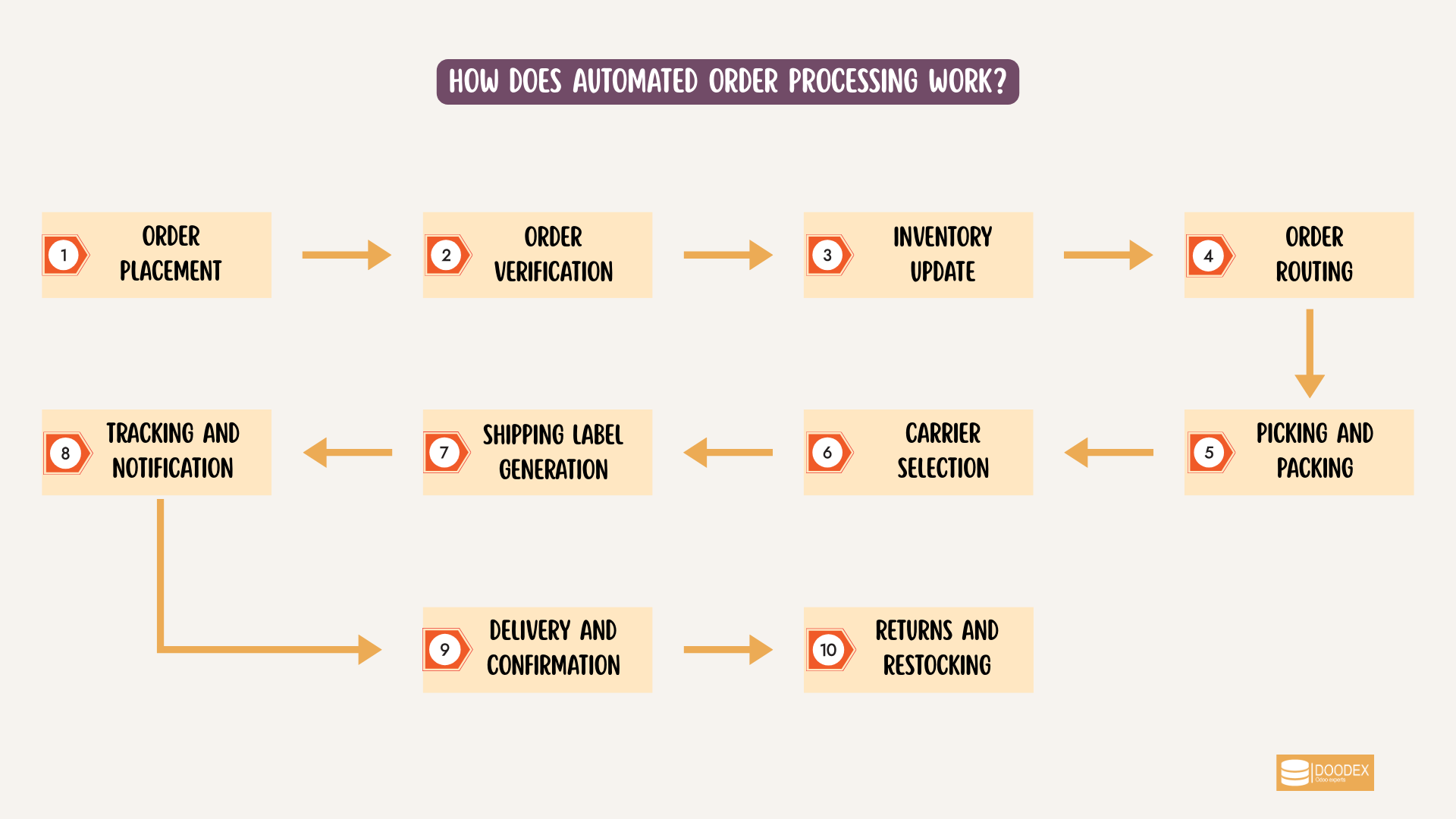
Automated manufacturing order flow
Manufacturing operations involve multiple moving parts: customer orders, raw materials, work centers, production capacity, and delivery deadlines. When these are handled manually — without an automated MRP software in place — manufacturers face recurring problems:
- Too much time spent on manual tasks
- Frequent data inconsistencies between systems
- Delayed production due to unavailable materials
- Limited real-time monitoring and decision making
- High dependency on individual operators
By implementing manufacturing automation in Odoo, manufacturers reduce manual intervention and gain full control over production processes.
Key benefits of automation
- Enhanced efficiency: Odoo automatically generates manufacturing orders based on demand.
- Reduced errors: Automation minimizes mistakes in order processing and material consumption.
- Better productivity: Teams focus on value-added work instead of repetitive tasks.
- Live overview: Real-time visibility into production status, stock levels, and work orders.
- Scalable operations: Processes remain stable even as order volumes increase.
Automating Manufacturing Operations with Odoo ERP
Odoo provides a modular and integrated approach to manufacturing automation. Its Odoo manufacturing ERP works seamlessly with inventory, purchase, sales, and accounting modules, creating a single source of truth for production.
How automation works in practice
When a customer places a sales order, Odoo can:
- Check product configuration and routes
- Verify component availability
- Trigger procurement or purchase orders if materials are unavailable
- Automatically create manufacturing orders
- Schedule work orders based on production capacity
- Track production in real time until delivery
This end-to-end automation ensures efficient manufacturing operations without manual re-entry or disconnected systems.
Adapt Odoo to Your Manufacturing Flow
See how tailored Odoo automation supports smoother production
Step 1: Configure Products and Manufacturing Settings
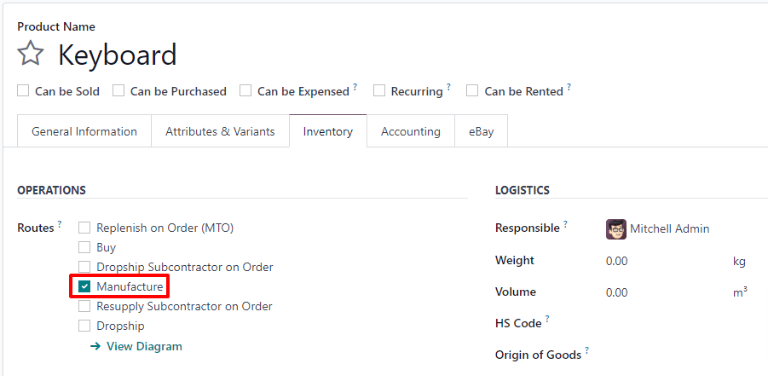
Odoo Manufacturing product setup with Manufacture route selected
Automation starts with proper configuration.
In Odoo Manufacturing, you define:
- Products to be manufactured
- Routes (Make to Order, Manufacture, Replenish on Order)
- Work centers and production steps
- Lead times and production capacity
Correct configuration ensures that Odoo understands when and how to produce each item.
Best practice
Always align product routes with real production logic. Incorrect routes lead to unnecessary stock or delayed manufacturing orders.
Step 2: Create and Manage Bills of Materials (BOMs)
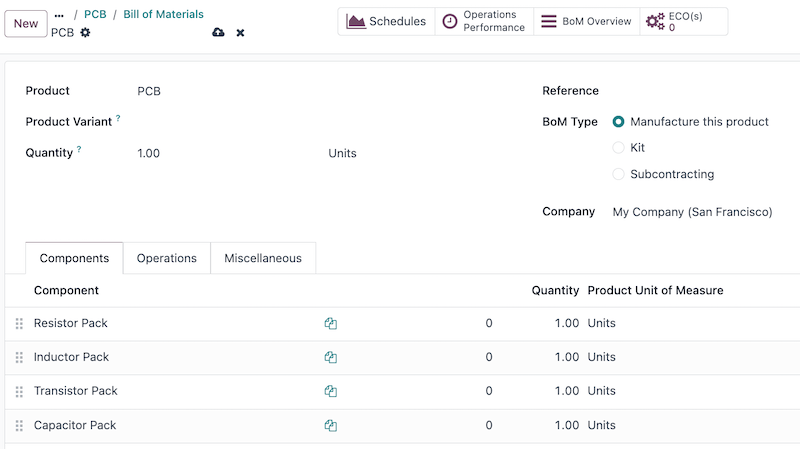
Odoo bill of materials configuration showing product components
The bill of materials is the backbone of manufacturing automation.
A BOM defines:
- Components required
- Quantities
- Optional by-products
- Production steps or operations
In Odoo, BOMs can be:
- Simple (single-level)
- Multi-level (sub-assemblies)
- Variant-based
- Flexible for engineering changes
Once a BOM is in place, Odoo automatically calculates raw materials, triggers stock moves, and reserves components for each manufacturing order.
Step 3: Automating Manufacturing Order Creation
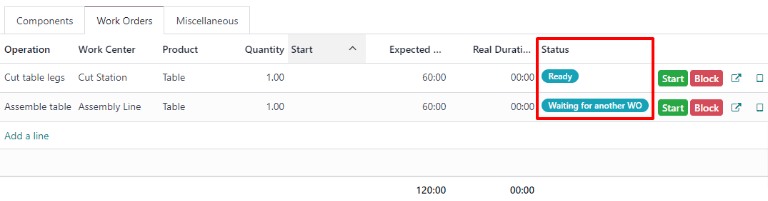
Odoo work orders with real-time status in manufacturing operations
With products and BOMs configured, Odoo manufacturing automation truly begins.
Manufacturing orders can be created automatically when:
- A sales order is confirmed
- Stock levels fall below minimum thresholds
- Forecasted demand exceeds available inventory
Odoo automatically generates:
- Manufacturing orders
- Work orders per work center
- Component reservations
- Production deadlines
This removes manual order creation and ensures consistent order processing.
Step 4: Production Planning and Scheduling
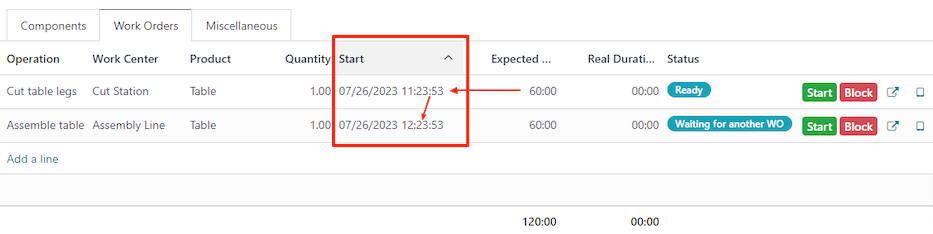
Odoo manufacturing work orders with start time scheduling
Efficient production requires accurate planning.
Odoo offers:
- Production scheduling
- Master Production Schedule (MPS)
- Gantt views for work orders
- Capacity planning per work center
With automation, Odoo balances:
- Customer orders
- Production capacity
- Available resources
- Delivery commitments
This prevents overloading work centers and improves on-time delivery. For a deeper look at how the MPS, Gantt scheduling and capacity planning fit together, see our guide to production planning and scheduling in Odoo.
Step 5: Real-Time Monitoring and Quality Control
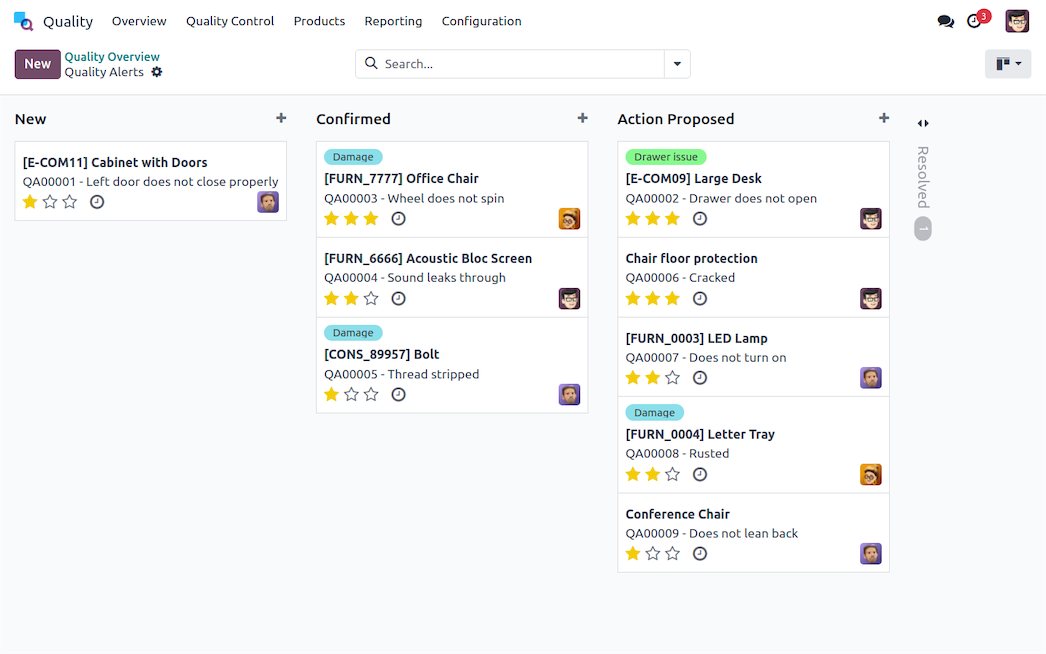
Odoo quality control dashboard showing real-time quality alerts
Automation does not mean losing control. In fact, Odoo increases visibility.
Manufacturers gain:
- Real-time monitoring of work orders
- Live production status updates
- Automated quality checks at each stage
- Test results recorded directly on manufacturing orders
Quality control points can be enforced automatically, ensuring that products move forward only when standards are met.
✨Pro Tip
Build once, scale safely
Start with core flows, then expand automation gradually.
Solid foundations → resilient operations.
Seamless Integration with Inventory and Purchasing
One of Odoo’s strongest advantages is seamless integration across modules.
- Inventory updates in real time as materials are consumed
- Stock levels are always accurate
- Purchase orders are triggered automatically when materials are unavailable
- Lot and serial tracking ensures traceability
This tight integration eliminates gaps between production, inventory, and procurement.
How Odoo Manufacturing Automation Improves Operational Efficiency
By automating manufacturing processes, businesses achieve measurable improvements:
- Reduced production lead times
- Lower operational costs
- Better resource allocation
- Improved delivery reliability
- Data-driven decision making
Manufacturers gain valuable insights into bottlenecks, costs, and performance using Odoo’s reporting tools.
Scaling Manufacturing with Odoo Modules
Odoo’s modular architecture allows manufacturers to scale gradually.
Common extensions include:
- Advanced quality control
- Maintenance management
- Product lifecycle management (PLM)
- IoT integrations for real-time machine data
As business needs evolve, additional Odoo modules can be activated without disrupting existing operations.
Partnering with DOODEX for Manufacturing Automation
While Odoo provides powerful tools, successful automation depends on correct design and implementation.
DOODEX specializes in manufacturing automation using Odoo ERP, helping manufacturers:
- Analyze production workflows
- Configure products, BOMs, and work centers
- Optimize production planning and scheduling
- Train teams for long-term adoption
- Deliver cost-effective, scalable solutions
A professional implementation ensures that automation aligns with real operational constraints, not just system defaults.
Build a Strong Odoo Manufacturing Setup
Ensure products, BOMs, and planning are configured the right way
Conclusion
Automating manufacturing orders with Odoo transforms manufacturing from a reactive process into a controlled, data-driven operation. By leveraging Odoo’s manufacturing module, manufacturers streamline production processes, improve efficiency, and gain full visibility across operations.
With proper configuration, automation eliminates repetitive tasks, improves quality, and ensures consistent delivery performance. For manufacturers aiming to scale while maintaining control, Odoo ERP offers a powerful and cost-effective foundation.
To accelerate results and avoid common pitfalls, working with an experienced Odoo partner such as DOODEX ensures a smooth transition from manual production to fully automated manufacturing operations.
FAQs
A manufacturing order is a document that controls the production of a product, including components, work orders, and production steps.
Yes. Odoo automatically generates manufacturing orders from sales orders, stock rules, or demand forecasts.
Odoo checks stock levels in real time and triggers purchase orders or replenishment when materials are unavailable.
Yes. Odoo supports multi-level BOMs, work centers, quality checks, and advanced production planning.
Automation reduces errors, waste, and time spent on manual tasks, resulting in lower operational costs.
Odoo’s modular structure allows manufacturers to scale production without rebuilding systems.
Yes. A free demo helps manufacturers evaluate Odoo manufacturing automation before implementation.